

Entrada de blog
October 29, 2025
Participation and Trust: The Uses and Limits of Algorithmic Impact Assessments
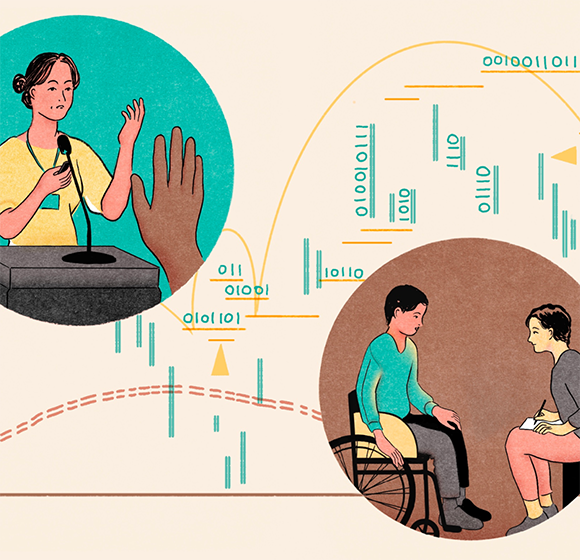
AIMLab works to develop methodologies for conducting empirical, participatory algorithmic impact assessments to support the governance of artificial intelligence.

As companies and governments rapidly introduce AI into everyday products and services, it is critical to first anticipate their impacts. AI predictions, recommendations, and decisions can sometimes be high-stakes, affecting a person’s well-being, health, or access to opportunities for credit, employment, and public services. These benefits and harms are rarely distributed evenly. Research shows that AI systems perform differently across lines of race, gender, class, ability, occupation, and power, differences that are too often overlooked before deployment. Algorithmic impact assessments (AIAs) are designed to bridge this gap; they help identify and evaluate potential impacts in advance, so risks can be mitigated and benefits more equitably distributed.
AIAs are emerging as a pillar of responsible AI deployment and have already been mandated for high-risk systems in several countries, and increasingly in state and local governments. Conventional approaches to AIA rely on self-reported checklists and procedures that demonstrate compliance but do not trace the qualitative experiences of people who would be impacted by AI deployment; if treated as a box-checking exercise, assessments are performative.
Our approach embeds evaluation within the places a system would be used, foregrounding dialogue with affected communities to build accountability relationships that move beyond technical documentation and reporting. Genuine dialogue between developers, policymakers, and the public ensures that AI systems are assessed for their likely real-world consequences.
The Algorithmic Impact Methods Lab (AIMLab) was launched in May 2023 to explore how algorithmic impact assessments can center the voices of impacted communities. Our goal is to shape emerging best practices as AIAs become increasingly mandated by law and policy, and to show how assessments can be driven by the concerns of those most affected.
Our pilots of community-based AIAs demonstrate that community engagement surfaces flawed assumptions, identifies on-the-ground needs, and helps anticipate failures. Our method for community-based AIA is now available; here you’ll find our toolkit for conducting AIA, documentation of our pilots, and reflections on lessons learned.
This work builds on prior research at Data & Society that analyzed algorithmic impact assessments (AIAs) as sociotechnical instruments rather than neutral tools, highlighting how their effectiveness depends on institutional and political context (Moss et al. 2021; Metcalf et al. 2021). Early critiques from this work underscored the risks of symbolic compliance and institutional capture if AIAs are treated merely as procedural checkboxes. Instead, our early scholarship emphasized that the success of AIAs depends on embedding them within infrastructures that support broad participation and continual self-examination of how decisions are made and justified. These findings called for practices that foreground affected communities and directly grapple with the structural conditions shaping algorithmic harm. It also found that too often, today’s AIA processes are missing this community engagement dimension, and that such two-way communication toward durable relationships between developers or deployers and impacted communities is essential for meaningful accountability.
See also:
– Metcalf, Moss, Watkins, Singh & Elish (2021) – “Algorithmic Impact Assessments and Accountability: The Co‑construction of Impacts.” Provides the conceptual foundation of AIAs, arguing that “impacts” must be co‑constructed with affected communities to ensure meaningful accountability. AIAs aren’t neutral: they are shaped by institutional contexts and can risk being superficial unless grounded in relationships.
– Moss, Watkins, Singh, Elish & Metcalf (2021) – “Assembling Accountability: Algorithmic Impact Assessment for the Public Interest.” A practical report that maps challenges of constructing AIAs by comparing them with impact assessments in domains like environment and human rights; it offers frameworks for embedding diverse expertise in the process.




Program Director, AI Civics