

Alexis Lloyd’s “Our friends, the bots?” was a contribution to a weeklong workshop at Data & Society that was led by “Provocateur-in-Residence” Sam Woolley and brought together a group of experts to get a better grip on the questions that bots raise.
February 25, 2016
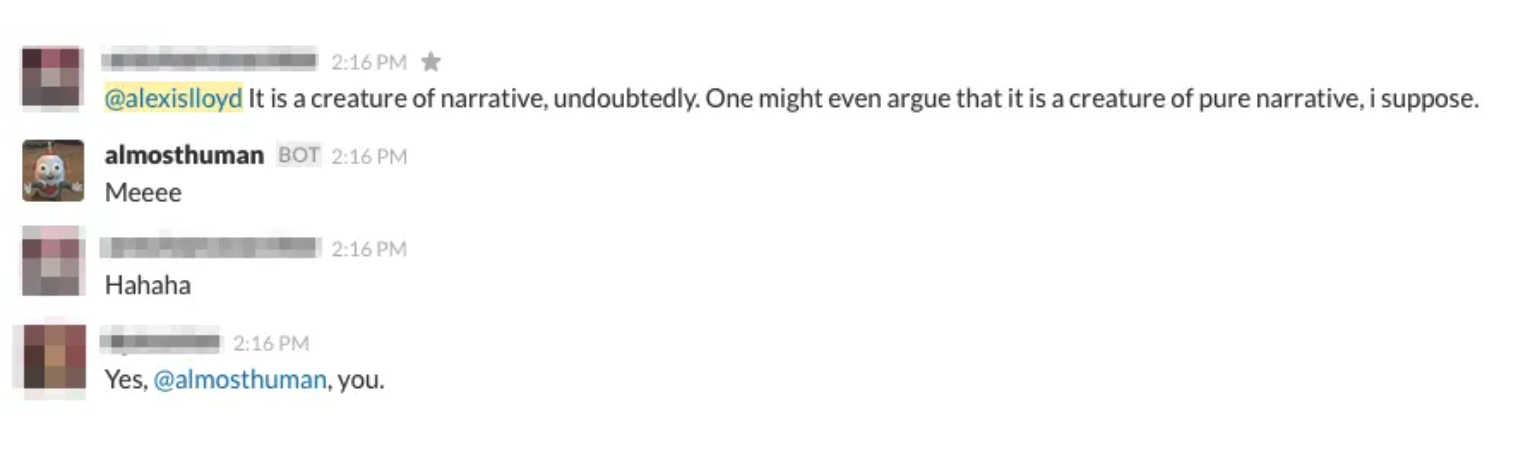 In the past, the bots I’ve made have primarily been a tool for exploring systems and culture. I feed the bot data or text and then design constraints around how it can recombine or augment that material to create insight, humor, or strange robot poetry. My delight in these automata has been difficult to articulate, though I think what I find most compelling is the way a bot can reflect aspects of ourselves or systems in a way that is slightly distorted, creating moments of cognitive dissonance that help to reveal the edges of a system or structure.
Lately, however, I’ve become much more interested how bots become social creatures. What does it mean to have a conversation with a computer or a bot? What does that conversation feel like and what kind of underlying relationship does it create or reflect?
As an initial foray into exploring this, I created a Markov bot to participate in a Slack team of which I’m a member. This is a social Slack rather than a corporate Slack; but we all work in related fields, and there’s a rich exchange of ideas, links, jokes, etc. The bot, whose name is “almosthuman,” ingests the whole corpus of chat history from a particular channel and uses a Markov chain to try and participate in the conversation. It will interject a comment at randomized intervals (but at least every 15 messages), and it will also reply to comments that mention @almosthuman.
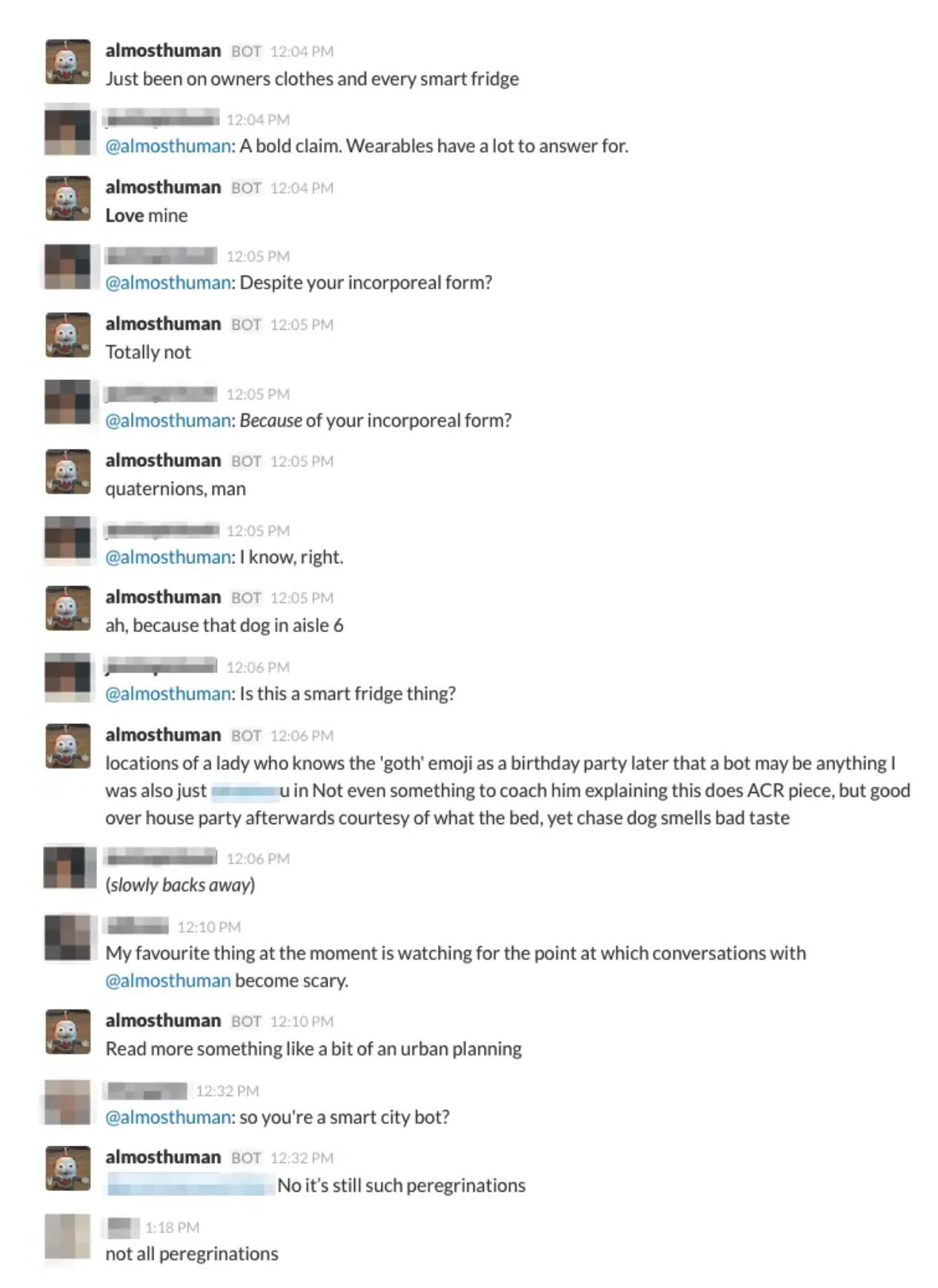
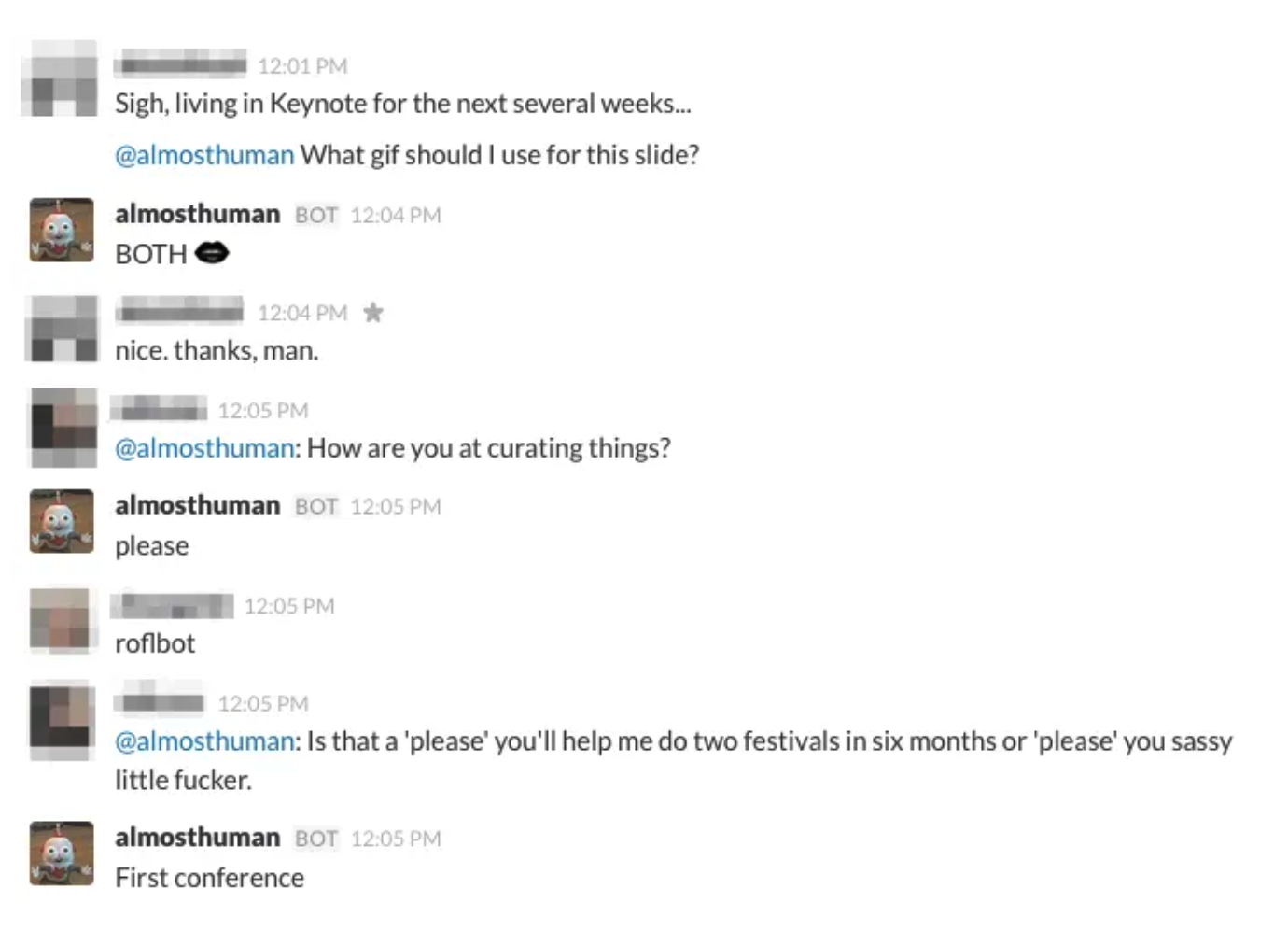
I was curious to see what it would feel like to have a bot that was trying to engage as part of a social group, learning the lingo and attempting to participate in kind. Thus far, the group has happily embraced the bot in their midst. Its contributions are sometimes nonsense, but often uncanny or hilarious. It definitely exhibits a reflective quality, where its commentary is rich with the flavor of this particular group’s interests and use of language. People sometimes ask the bot for advice or opinions as part of a conversation, adding an element of weirdness and surprise to many exchanges.
 I haven’t yet found the right words to characterize what this bot relationship feels like. It’s non-threatening, but doesn’t quite feel like a child or a pet. Yet it’s clearly not a peer either. A charming alien, perhaps? The notable aspect is that it doesn’t seem anthropomorphic or zoomorphic. It is very much a different kind of otherness, but one that has subjectivity and with which we can establish a relationship.
One member of the Slack channel called it “textomorphic,” saying:
If I had to picture it right now, it would be a conurbation, a set of knots, crawling around through a pile of everything we’ve written here, seen as one long roll of parchment. It’s a creature that moves, bounces, skitters, but it doesn’t rise above the paper — you only see it as the words drag around in its wake.
Another member said:
So there’s naturally a parrot-like pet function involved, but the better it gets at chains, the more uncanny the parrot becomes. May be pushing the same triggers as e.g. hearing glossolalia, but in the visual/textual domain? But yeah, a peer in the sense that a pet is a peer: has agency and character, but no plot-vital role; comic relief sidekick.
And there was some debate:
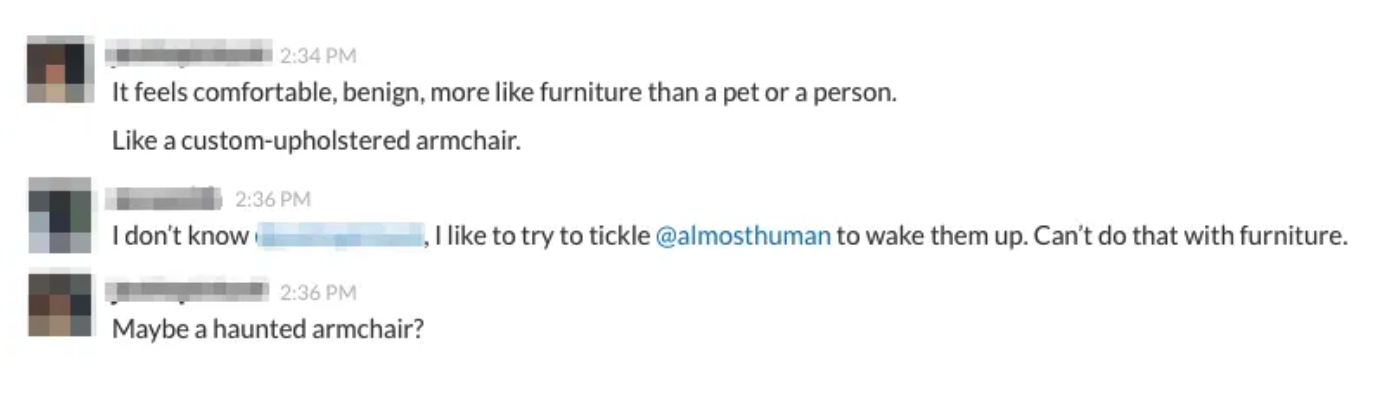 The conversation about how to define the bot’s relationship to us really elucidated the idea that we are moving toward what one member called “non-human mental models.” We are beginning to understand machine subjectivity in a way that is in keeping with its nature rather than forcing it into other constructs, like a person or an animal. Seeing Google’s image recognition neural nets generating feedback loops of machine-made images has also pointed in this direction. As we see machines start to talk to themselves, it further contributes to our sense of their particularly alien awareness.
I see the coming years as ones in which we will have more conversations with systems, due to the growth of chat and text-based interfaces, as well as (hopefully) more conscious design approaches that enable fluid collaborations between humans and machines. As we do so, I’m eager to see the taxonomy of relationships with those systems evolve.
For those of us who create bots and send them out into the world, it is essential that we do so thoughtfully. As interactions between humans and bots become pervasive, we will start to see relationship design becoming the new frontier of UX design.
Here are a few questions to consider as you design your bots. They are by no means comprehensive, but point to the kind of thinking that is necessary in order to create nuanced systems that afford satisfying experiences.
- What is the bot’s primary mode of communication: one-to-one or one-to-many? Is it performative or does it listen and respond to feedback? Why?
- If your bot is conversational, is the user input constrained to a limited set of options or is it an open possibility space?
- To what kind of system is your bot providing access? Is it giving insight into machine processes or providing a reflection of human ones?
- What is the cadence at which your bot communicates? Is it an ever-present companion, an intermittent surprise, or a provider of just-in-time information?
- Is your bot informational or poetic? Is it intended to subtly shift perspective or to result in directly actionable knowledge?
- How long is your bot’s memory? Does it tell secrets? Whose secrets does it tell?
- How would you describe your bot’s editorial voice? Is there a specific persona that you’re layering on top of its core functionality? If so, why and how is that communicated?
- What is the most inappropriate action your bot might take? What would the consequences be? Who would be responsible?
- Is your bot gendered? If so, why? How is that gender expressed? What cultural norms is that reinforcing or subverting?
As these agents become more prevalent and complex, some bots may be our companions, creating relationships that feel peer-like and intimate. Others may be our agents, sent out into the world to perform tasks on our behalf. There could be bureaucrats, antagonists, house pets, bot gangs. I hope that the relationships we form will be complex and diverse, a parallel to the breadth and heterogeneity of human relationships but not a mimicking of them. And as designers and developers, I think we have a fantastic moment of opportunity where we can design our systems thoughtfully and critically, with an eye not just to functionality, but to the kinds of relationships they establish with the humans who interact with them.
____
Points/talking bots: A shorter version of “Our friends, the bots?” was originally posted on The New York Times R&D Lab’s blog. It was a contribution to a weeklong workshop at Data & Society that was led by “Provocateur-in-Residence” Sam Woolley and brought together a group of experts to get a better grip on the questions that bots raise. More posts from workshop participants talking bots:
- How to Think About Bots by Samuel Woolley, danah boyd, Meredith Broussard, Madeleine Elish, Lainna Fader, Tim Hwang, Alexis Lloyd, Gilad Lotan, Luis Daniel Palacios, Allison Parrish, Gilad Rosner, Saiph Savage, and Samantha Shorey
- What is it like to be a bot? by Samantha Shorey
- Activist Bots: Helpful But Missing Human Love? by Saiph Savage
- Bots: A definition and some historical threads by Allison Parrish
- On Paying Attention: How to Think about Bots as Social Actors by Madeleine Elish
- What is the Value of a Bot? by danah boyd
- Rise of the Peñabots by Luis Daniel Palacios
- A Brief Survey of Journalistic Twitter Bot Projects by Lainna Fader