


Botivist, a system for coordinating activist bots that call people to action to recruit them for activism.
November 29, 2015
Political bots are everywhere, swamping online conversations to promote a political candidate, sometimes even engaging in swiftboating…But, instead of continuing to build more political bots, what about creating bots for people, e.g., activists? What do bots for social change look like?
It might help us to first think about when might activists need bots?
Activists can suffer extreme dangers, including being murdered. Given that bots can remove responsibility from humans, we could think of designing bots that execute and take responsibility for tasks that are dangerous for human activists to do. At the end of the day, what happens if you kill a bot?
Our interviews with activists have also highlighted that activists have to spend excessive time in recruitment, i.e., trying to convince people to join their cause. While obtaining new members is crucial to the long term survival of any activist groups, activists spend sometimes excessive time trying to convince people who at the end might never participate. Plus, it can be hard for humans to test and rapidly figure out what recruitment campaigns work best: is it better to have a solidarity campaign that reminds individuals of the importance of helping each other? Or is it more effective to just be upfront and directly ask for participation? The automation aspect of bots mean that we could use them to massively probe different recruitment campaigns, and not have humans spend too much time in these tedious tasks.
These ideas about how task automation could help activists lead us to design Botivist, a system that uses online bots to recruit humans for activism. The bots also allow activists to easily probe different recruit strategies.
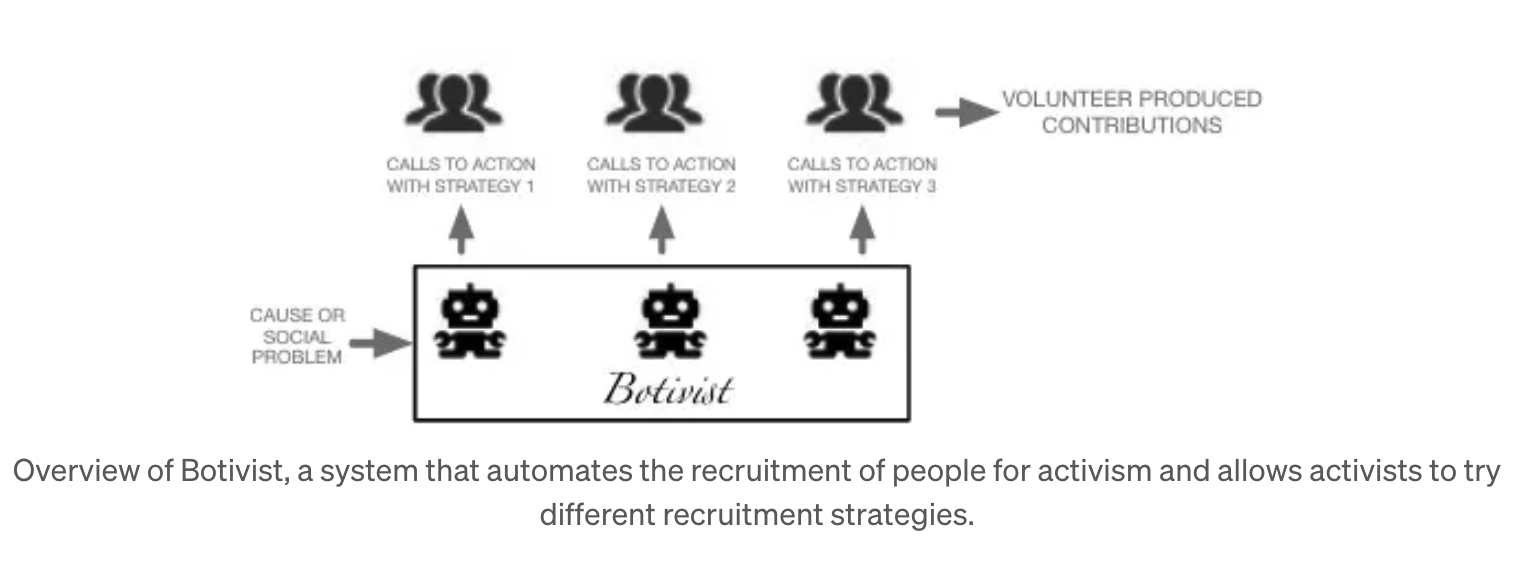
We conducted a study on Botivist to understand the feasibility of using bots to convince people to participate in activism. In particular, we studied whether bots could recruit and make people contribute ideas about tackling corruption. We found that over 80 per cent of the calls to action made by Botivist’s automated activists received at least one response. However, we also found that the strategy the bots used did matter. We were surprised to discover that strategies that work well face-to-face were less effective when used by bots. Messages effective when done by humans resulted sometimes in circular discussions where people questioned whether bots should be involved in activism. Persuasive strategies resulted in general in less responses from people.
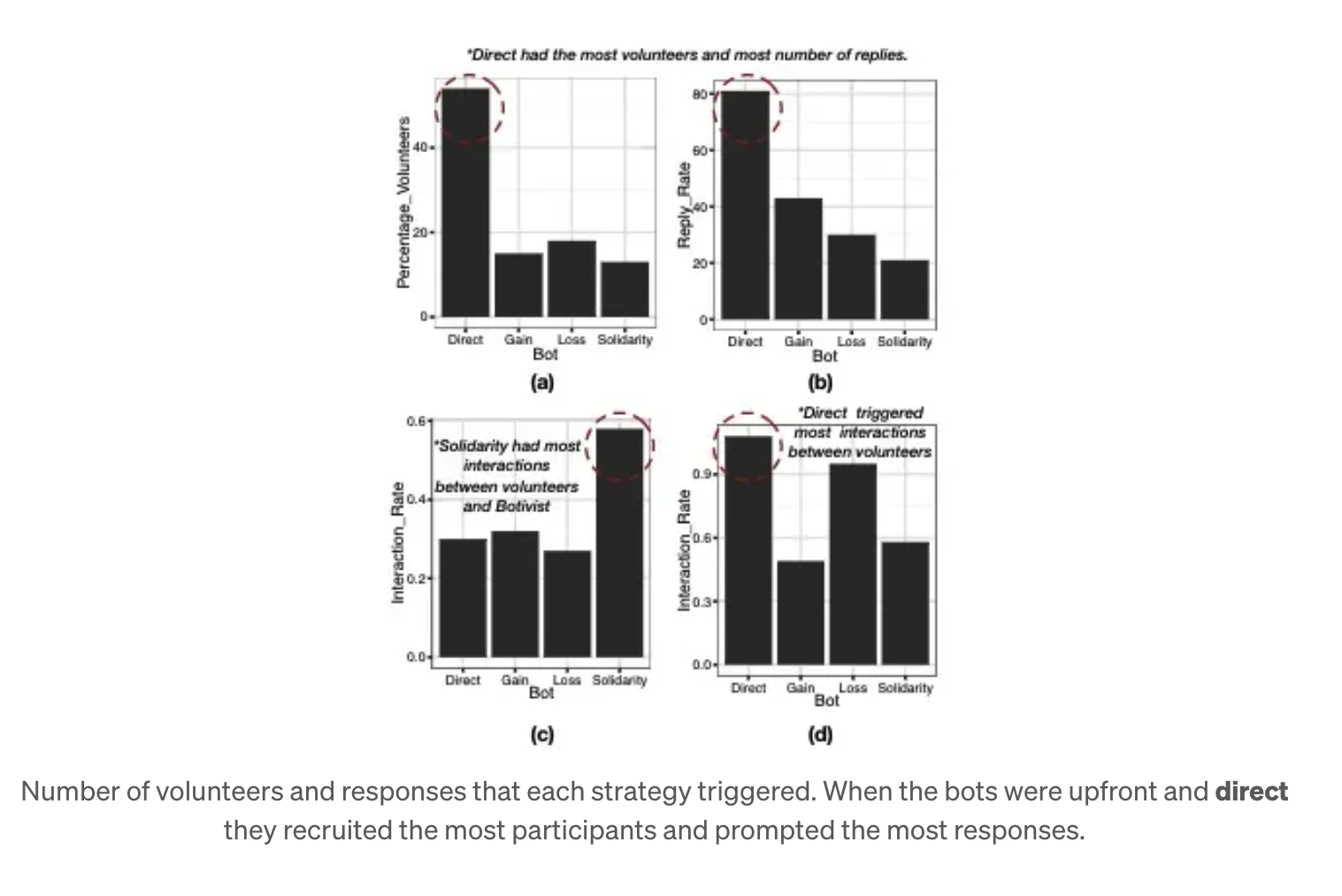
The individuals who decided to collaborate with Botivist were individuals already involved in online activism and marketing. They mentioned hashtags and Twitter accounts related to social causes and marketing analytics. It is likely that people linked Botivist to online marketing schemes. Therefore, those who responded to Botivist were the ones who in their communities already engage with such marketing agents, it was perhaps more natural for them.
To design bots for activists, it is necessary to understand first the communities in which the bots are being deployed. If we want to design bots that can take on some of the more dangerous activities of human activists, we have to first understand how people react when an automated agent conducts now the task. Will it be as effective as when done by a human? Many activists who endanger their lives making timely reports of terrorists or organized criminals are usually very empathic, caring, and have great solidarity with their public. Will it matter when these task are now done by an automated agent who by nature cannot care?
To read more about our system Botivist, checkout our CSCW 2016 research paper:Botivist: Calling Volunteers to Action Using Online Bots,
with Saiph Savage, Andres Monroy-Hernandez, Tobias Hollerer.
_____
Points/talking bots: “Activist Bots: Helpful But Missing Human Love?” is a contribution to a weeklong workshop at Data & Society that was led by “Provocateur-in-Residence” Sam Woolley and brought together a group of experts to get a better grip on the questions that bots raise. More posts from workshop participants talking bots:
- How to Think About Bots by Samuel Woolley, danah boyd, Meredith Broussard, Madeleine Elish, Lainna Fader, Tim Hwang, Alexis Lloyd, Gilad Lotan, Luis Daniel Palacios, Allison Parrish, Gilad Rosner, Saiph Savage, and Samantha Shorey
- What is it like to be a bot? by Samantha Shorey
- Bots: A definition and some historical threads by Allison Parrish
- Our friends, the bots? by Alexis Lloyd
- On Paying Attention: How to Think about Bots as Social Actors by Madeleine Elish
- What is the Value of a Bot? by danah boyd
- Rise of the Peñabots by Luis Daniel Palacios
- A Brief Survey of Journalistic Twitter Bot Projects by Lainna Fader