

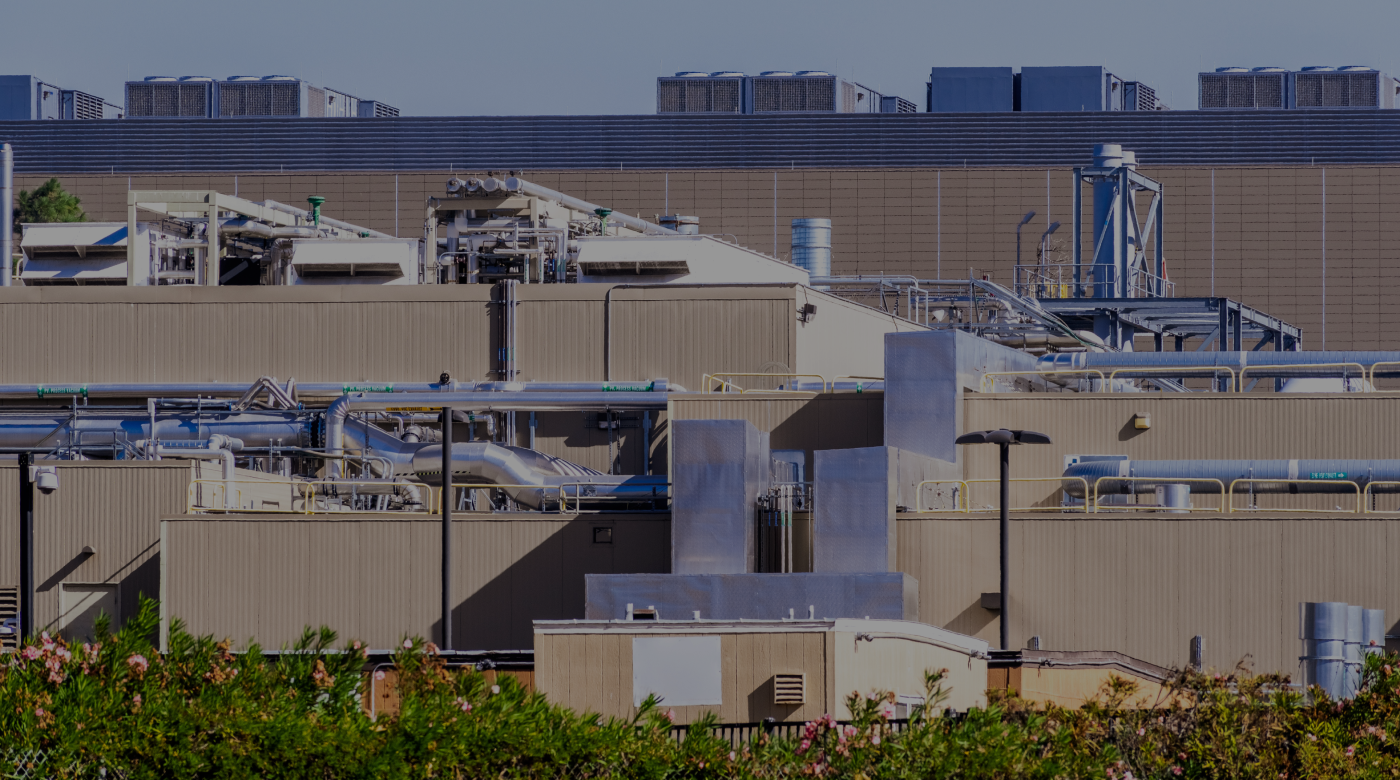
Tamara Kneese and Cecilia Marrinan consider how California’s longstanding ties to the tech industry — and a history of environmental harm — connect to the threats the industry poses to the state today.
By Tamara Kneese and Cecilia Marrinan
December 3, 2025
California is historically, politically, and economically tied to the tech industry. Though California may not have the massive hyperscalers we see in places like Louisiana and Texas, it has a high proportion of the nation’s data centers, including many that predate the generative AI boom. By 2030, California data centers could use the same amount of energy as adding another city the size of Los Angeles to the grid. California has yet to pass legislation mandating transparency around data centers’ energy and water usage. The state is also characterized by extreme wealth inequality, and many communities face digital redlining despite bearing the brunt of industrial pollution.
As we witness the rapid expansion of data centers, it is crucial to recognize how this expansion echoes Silicon Valley’s problematic history — mirroring forms of environmental racism and ecological violence under the guise of “AI hype.” Through their misleading hype narratives, Big Tech has managed to obscure and divert attention away from the physical consequences of the Cloud. To understand the threats the industry poses today, it is essential to examine the past irreparable harm caused by tech-industrial pollution in Californian communities. In 1981, Fairchild Semiconductor was to blame for a leaking chemical solvent tank that contaminated San Jose’s drinking water wells, leading to the creation of the Silicon Valley Toxics Coalition, a grassroots nonprofit organization. The group connected chemical exposure’s effects on workers, who experienced miscarriages, birth defects, and high cancer rates, to the industry’s pollution of nearby groundwater and soil, thus connecting reproductive justice, environmental protections, immigrants’ rights, and labor rights. The issues that Silicon Valley Toxics Coalition organized around reverberate in the present day: According to a 2023 CalMatters investigation, hazardous-waste processing plants that handle the tech industry’s waste are operating with expired permits, predominantly in communities of color, and have poorly maintained wells that leak contaminants into the environment.
More recent physical manifestations of tech development, such as warehouse infrastructures in working-class communities of color, spurred mobilization from environmental justice groups and frontline communities. In some cases, this prompted wins against warehouse expansion in various parts of California, like the Inland Empire. Today, some former distribution centers and other relics of previous industrial eras are being repurposed for data centers. A former golf course in the East Bay suburb of Pittsburg, for example, was set to be turned into a data center, and a lawsuit from the Center for Biological Diversity helped stop the project.
While data center development follows the pattern of previous industrial waves, there are unique elements in this moment of data center accelerationism and AI ascendence. To fully assess the relationship between regulatory efforts and data center expansion, we must consider the broader federal political landscape. The Trump administration has quietly removed hundreds of federal datasets, such as the Environmental Protection Agency’s (EPA) Environmental Justice Screen, from government websites. This removal of important datasets may result in the loss of history and increase concerns about the disappearance of data vital to ongoing research, highlighting the interconnected effects of infrastructure on communities living in sacrifice zones — areas treated as collateral damage in the name of innovation and technological progress. Additionally, the Trump administration’s executive order to accelerate data center expansion has directed the EPA to identify Superfund and Brownfield sites for potential data center development. California ranks as the second-highest state for Superfund locations.
In response to increasing public scrutiny, companies have touted net zero goals along with public engagement initiatives. For example, Google claims it wants to minimize the net climate impact in the future, yet the company is currently investing $4B in a hyperscaler data center campus five miles from xAI’s infamous hyperscaler in South Memphis, an area with the highest asthma rates in the country. Simultaneously, companies like Microsoft claim that AI will help them reach their sustainability goals. However, even with bold renewable and net-zero energy claims, these goals don’t address concerns like biodiversity, land use, and water cost, and they fail to address the reality that energy demand is outpacing the availability of renewables. Net zero and “green” claims are misleading and insufficient when data centers are built in overburdened communities that are already struggling with poor air quality, inflicting and replicating harm within host communities.
Recognizing the cultural, social, and economic harms from the tech industry’s growth illuminates how an imagined techno-future is haunted by the past. From the displacement of West Oakland’s Black community to make way for the Oakland Port’s rapid expansion to the siting of data centers in already overburdened neighborhoods like Bayview-Hunters Point in San Francisco, analyzing the Cloud’s intersecting injustices is essential to recognize patterns of systemic neglect.
In Conversation: Data Centers, Environmental Impacts, and Community Organizing
All of this is why, for its first public event, the California Data Center Working Group made a point of convening speakers who could address the history of community organizing around environmental justice issues, alongside experts on the technical aspects and policy debates surrounding data centers’ environmental repercussions. In an online event on October 9 co-hosted by Data & Society’s Climate, Technology, and Justice program and the Kapor Foundation, Khari Johson (CalMatters), Masheika Allgood (AllAI Consulting), and Nicole Merino Tsui (West Oakland Environmental Indicators Project) revealed how tech companies use metrics to obfuscate their true impacts. They also explored methods for collecting data from the ground up, providing communities with viable counterdata to oppose the rhetoric of tech companies that claim their impacts are minimal. And they discussed successful policy interventions, especially within communities that are already activated and ready to organize, as well as the ways that policy initiatives have fallen short or have been watered down in the legislative process.
Merino Tsui described how AB 617, which established the Community Air Protection Program, was effective because of the close collaboration between the Bay Area Air Quality Management District and the community of West Oakland, the first AB 617 community. West Oakland Environmental Indicators Project (WOEIP) brought residents out to ensure they had the information they needed to understand what solutions were possible. The West Oakland Community Action Plan was completely community-driven. In the best case scenarios of community organizing and policy interventions working together, communities can participate and push government agencies to complete the strategies they collectively agreed upon. However, WOEIP’s success was the exception; other California AB 617 communities haven’t had the same kind of success as West Oakland, based on the nature of their air districts and their communities, and the realities of funding cuts. Merino Tsui emphasized the need for academic partnership and meaningful data collection to support community demands, regardless of what policy measures are in place. Communities need to be prepared for the data center fights ahead.
Johnson detailed how bills in the California 25-26 legislative session pushed for more transparency around data centers’ water and energy usage, and how some regulatory efforts were stymied by lobbyists and political interests. SB 57 would have prevented ratepayers from bearing the costs of data centers’ energy use in California, but lobbyists gutted the bill. The Data Center Coalition allows companies like OpenAI to hide behind a group, obscuring public awareness that it is company representatives who are actually killing bills. Johnson stressed the importance of tracking policy initiatives across regions, especially as every county might have a unique set of political, social, and environmental factors that shape data center discourses, while also pointing to the need for journalists to uplift stories from communities.
Allgood described her transformation from an AI ethicist and product manager at Nvidia to an advocate who is using her legal knowledge and technical skills to empower communities. Concerned about AI’s use of water, she responded by producing Taps Run Dry, a platform that includes a calculator for assessing how much water AI uses. The calculator’s projection of alarming water use led Allgood to assess data centers’ air quality impacts and electricity use, using her platform to highlight how these interconnected factors can easily compound harms in communities. While California has had data centers in some form since the 1990s, Allgood discussed how companies take advantage of the Small Power Plant Exemption Act, building 99 megawatt centers used for generative AI and using diesel backup generators that pollute areas that already have poor air quality. AllAI Consulting created a community toolkit, with a set of guidelines for community members who are concerned about data center expansion, to help share her knowledge.
This event was a continuation of a conversation started by Data & Society in April 2025: As part of SF Climate Week, D&S partnered with Tech Workers Coalition to host an online event on data centers, climate, and labor issues and a related in-person event (audio available here, plus photos) at a community space in Oakland, which considered The Pacific Circuit — Alexis Madrigal’s book about Ms. Margaret Gordon’s organizing as cofounder of the West Oakland Environmental Indicators Project (WOEIP) — in conjunction with Xiaowei Wang and Ann Chen’s research on electronics manufacturing, pollution, and occupational health in Korea and Taiwan, on the other side of the Pacific Circuit from the Port of Oakland.
As our working group grows, we hope to foster more discussions like these. In an online Data & Society event on December 11, Tamara will be in conversation with Eliza Pan of Amazon Employees for Climate Justice to mark the launch of her new report, Turning the Tide: Climate Action in and Against Tech; the discussion will be moderated by Khari Johnson. Later that evening, Tamara will speak on a panel titled “AI and the Environment — Shaping a Sustainable Future” at the San Francisco Public Library’s Koret Auditorium, along with fellow California Data Center Working Group members Khari Johnson and Iris Stewart-Frey (Santa Clara University).
Also on the horizon: On December 9, the Kapor Foundation will release The Unequal Burden of Data Centers: An Examination of the Environmental and Public Health Impacts on Communities in California, a new report highlighting the environmental and health risks posed by the rapid expansion of AI infrastructure across California.
Resources: California Data Centers in Context Event
– “California Lawmakers Wanted to Get Tough on Data Centers. Here’s What Survived,” CalMatters
– The Pacific Circuit by Alexis Madrigal
– Semiconductors: A Field Guide
– “AI Data Centers are Sending Power Bills Soaring,” Bloomberg
– “Spencer Plans to Codify New Regulations for Data Centers By Executive Order,” St. Louis Magazine
– IESO Demand and Conservation Planning Technical Paper: Large Step Loads
– “Why Tax Breaks for Data Centers Could Backfire on States,” TIME
– “The Fallacy of Closed-Loop Cooling Systems,” Eat Your Frog Substack
– West Oakland Air Quality (WOAQ) Monitoring Network (WOEIP)
– “What Big Tech and Big Tobacco Research Funding Have in Common,” Venture Beat
– San José’s Civics Masterclass Module One: Government 101
– Correction: During the event, it was stated that SB 404 was signed into law. This was incorrect, and Governor Newsom has vetoed SB 404.
Tamara Kneese is the director of Data & Society’s Climate, Technology, and Justice program. Previously, she led Data & Society’s Algorithmic Impacts Lab (AIMLab). Building on the participatory impact assessment frameworks developed at AIMLab, she is the principal investigator of a NSF ReDDDoT planning grant that will engage the communities most impacted by AI’s infrastructures, including data centers, to go beyond technical measurements of carbon emissions. Before joining D&S, she was lead researcher at Green Software Foundation, director of developer engagement on the green software team at Intel, and assistant professor of media studies and director of gender and sexualities studies at the University of San Francisco.
Cecilia Marrinan is the tech policy associate at the Kapor Foundation, where she works to create a more equitable technology ecosystem by addressing racial and socioeconomic disparities. Her prior experience includes positions at the White House Office of Public Engagement, the National Geographic Society, the Council on Foreign Relations, and Encode. In 2020, she founded Skaneateles for Social Justice, where she organized a Black Lives Matter march and partnered with her local school district to increase diversity, equity, and inclusion in its curriculum.