

As big tech companies appeal to small island countries’ anxieties about being left behind, Emma Quilty considers how efforts to transform islands into digital hubs obscure the power and agency of these places and their people.
Confronting Data Centers, Deep-Sea Cables, and Colonial Legacies in the South Pacific
The Cloud is Dead: A Series on Living with Legacies of Resource Extraction

By Emma Quilty
September 17, 2025
Tropical paradise. Smiling faces. This is the fantasy Fiji has successfully sold to the world. And as I drive along the West Coast of Viti Levu, the archipelago’s largest island, the scenery does indeed resemble a tourist advertisement: crystal-blue ocean water, white sandy beaches, and lush tropical forests hugging the shoreline. But Fiji is more than breathtaking landscapes. While most people are aware of the rapid rise of data centers in the US and Europe, the creeping influence of tech giants like Google and Starklink can be seen and felt here, too.
Starlink, a subsidiary of American aerospace company SpaceX (owned by Elon Musk), was launched in Fiji in May 2024 and has quickly integrated itself into the local telecommunications ecosystem. Late that same year on the West of Viti Levu, Google broke ground on a future data center facility that will also house four Google-built subsea cables. The Southern Cross Cable, Fiji’s first subsea cable, was connected on the east coast of the island close to the capital city, Suva, in 2000. Natadola Bay, the chosen site for Google’s future ICT Facility and new cables, is not located near the nation’s capital city. It is, however, conveniently located next to the world-renowned golf course and five-star luxury resort, a fitting location for a project that builds on the colonial legacies of the Pacific.

A subsea cable marker on Natadola beach.
Cutting through the Intercontinental Golf Resort is a set of railway tracks, too small to carry people, but the perfect size for transporting sugar cane. Most of the hotel’s guests would be unaware that during the 19th and late 20th centuries, sugar was produced and refined in Fiji and exported all over the British Empire.
As a post-abolitionist colony, Fiji did not use slave labor to work on the plantations, but nor were the Indigenous Fijians (iTaukei) employed, as their labor was protected under the colonial rule. To fulfil its need for labor on the plantations, the British Empire introduced the Indian indenture system, by which more than 1.6 million workers from British-occupied India were transported to plantations throughout the empire’s colonies.
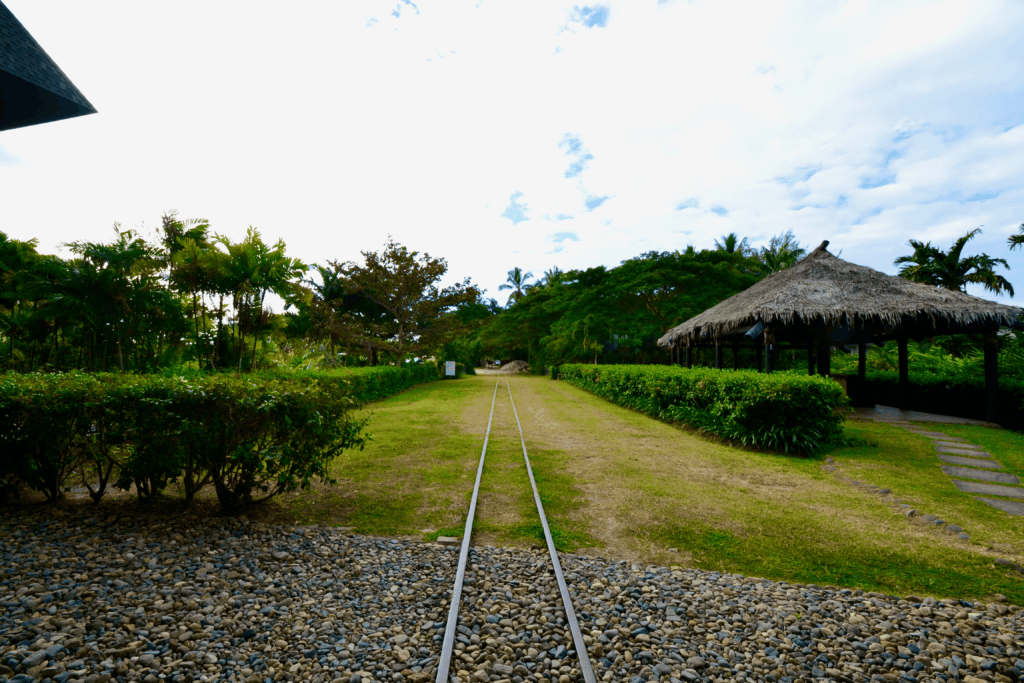
Sugar Cane railway tracks running through the Intercontinental Golf Resort.
While the Indian indentured laborers were kept on the plantations and the iTaukei people were encouraged to remain in their villages, living a more traditional lifestyle, the two populations were kept geographically separate to help maintain colonial control. The British colonists built their company towns away from both groups, near the railway network that hugs the coastline, many sections of which are elevated with spectacular views of the ocean. Google’s choice of Natadola Bay as the landing site for the cables and the data center represents a continuation of this colonial impulse to build infrastructure in scenic places, far from reminders of problems like poverty, gender inequality, gender-based violence, and inadequate housing — which in Fiji are at least as real as its famous crystalline waters.
As I follow the train tracks, the meticulously manicured lawns of the resort slowly turn into a construction site with piles of rock, soil, and cables behind a haphazardly constructed metal fence. The construction site is shielded on one side by vegetation, and on the beachfront by bures offering resort goers massages, hair-braiding, and horse rides.
Colonial investments in infrastructure, resorts, roads, railways, and telecommunication systems played a crucial role in promoting the unequal economic systems that persist to this day. Layered both literally and figuratively on top of the future pathway of the Google internet infrastructure, the sugarcane railway tracks evoke the longevity of colonial infrastructures as well as the ideologies underlying them.
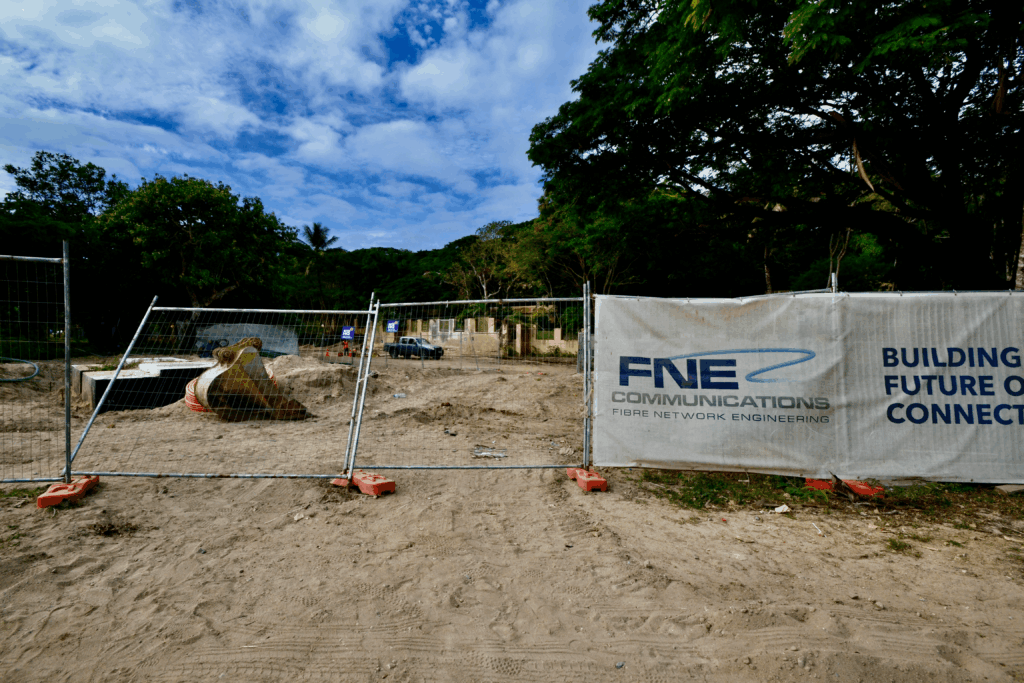
Construction of the terrestrial cable, connecting Google’s subsea cable with Viti Levu.
Today, companies like Google are directly playing on small island countries’ anxieties about “being left behind in the age of technology” and the need to invest in internet infrastructures to “overcome the challenges of geographic isolation and participate in the global digital economy.”
Much of the media coverage of Google’s future subsea cables focuses on the company’s role in transforming Fiji into “a beacon for innovation and a model for economic resilience in the Pacific.” Yet this seemingly innovative infrastructure relies on colonial ideologies and practices, particularly the idea that islands are isolated and bounded. Islands, as Nicole Starsoleski explains, are typically defined in terms of their exclusion from the infrastructures that support modern societies.
Islands actually enable connectivities, from trade routes to undersea networks of subsea cables between global powers. Yet this typically Western perspective suggests that they are disconnected from the rest of the world. It also positions small island nations in an uneven power differential: seemingly reliant on larger nations and foreign companies, while obscuring the ways that those bodies in fact rely on the islands. And it paints countries in the South Pacific as passive actors, lacking agency. This happens so often that the region is routinely described as a power vacuum, and positioned as a vulnerable playground for more dominant players.
A number of geo-political tensions have likely played a part in Google choosing Fiji to transform into a “digital hub.” When it comes to cable services in the Pacific, there has never been one particular state or corporate entity dominating the market; however, in the last five years, competition between China and the US (via privately owned companies) over data infrastructure has increased dramatically. The Pacific has emerged as what some are calling “the frontline of the tech war,” with the rise of China as a global power and China’s “Digital Silk Road” strategy seen as a potential threat to the hegemonic American control.
There are also clear and pressing risks to information security in the Pacific, including environmental threats. In 2022, a volcanic eruption damaged an undersea fiber-optic telecommunication cable in Tonga. In response, the telecommunication infrastructure project Google is undertaking comes with broader promises to bring security and resilience both to Fiji and the wider Pacific region, part of a narrative the company is carefully crafting about how its project will benefit the region and the possibilities it will enable. One widely cited report made several ambitious projections about the future benefits of Google’s infrastructure project, including claims that it will contribute USD 295 million to Fiji’s GDP between 2024 and 2030 and support the creation of close to 3,600 jobs in 2030. Research on data centers indicates that such projections and promises, especially regarding job growth, can be inflated or flat-out misleading.
When I spoke to a representative of one of the Fijian government’s telecommunication bodies, they said there had been “no public interaction over those investments, the only consultation concerned the environment and creating employment opportunities for cable engineers, and data center engineers that are already here in Fiji.” The lack of community consultation is concerning. Across the world, the public is slowly becoming more aware of the environmental impacts of data centers, especially those needed to support artificial intelligence. What is less discussed is how the impacts disproportionately affect Black and Indigenous communities. While there is emerging research focused on these impacts in the United States and Europe, there is little work being done on how those in the Global South, especially the Pacific, are at risk of exploitation, extraction and environmental racism. In the Pacific, where Indigenous people often comprise a large percentage of populations (in Fiji, for example, the iTaukei are the majority), it is critical to pay attention to how tech companies are reshaping islands into temporary nodes for data extraction and accumulation.
This raises a number of questions: What are the social and material impacts of expanding privately owned telecommunications infrastructure for the people living in the Pacific, especially given the disproportionate impacts on Indigenous communities? How can we challenge the narratives that are already being used to reshape places like Fiji in the name of value extraction? And importantly, in the context of Fiji’s colonial legacy, who is included in these anticipatory narratives and who is being left behind?
It is critical to interrogate the interests and imperatives of the US-owned companies looking to expand the reach of their telecommunications infrastructure. After all, the expansion of Google’s data center industrial complex and undersea network into the Pacific is not a novel idea, nor a recent development. It follows the same well-worn paths initially carved by British colonial trade routes and later by the US imperial telecommunication networks. Whatever the future holds for the Pacific, we must reflect on the invisible ways these colonial processes continue to influence the design and deployment of internet infrastructures — or risk cementing power asymmetries both on the islands and beyond.
All photos by Emma Quilty.
Emma Quilty is a social anthropologist who works in the field of feminist science and technology studies. Based at Monash University, she is a research fellow in the Centre for Excellence for The Elimination of Violence Against Women. She studies shifting practices of algorithmic harm and gender violence, and how they are facilitated by digital infrastructures and emerging systems like artificial intelligence. Her book Witch Power, based on in-depth ethnographic research with contemporary witchcraft communities, explores dynamics of gender, power, and resistance. She also co-authored Can We Trust Technology? an ethnographic study with software engineers and other stakeholders on the socio-politics of trust and digital technologies.