

Priya Goswami looks at what happens when the work of India’s trusted door-to-door healthcare workers, known as ASHAs, extends into data collection.
From Care Labor to Data Labor: India’s Door-to-Door Health Activists
From our series Democratizing AI for the Global Majority
By Priya Goswami
November 19, 2025
Around the world, the bulk of care labor is borne by marginalized women. Such patterns reappear in our current and emerging technologies: from virtual assistants like Alexa and Siri to on-the-ground workers, care labor is often seen as female or feminized. But what happens when care labor extends to data labor, without consent or the possibility to opt out?
While Alexa and Siri are fashioned in Silicon Valley, in the heart of India, another kind of “assistant” is at work: community health activists deployed in the service of people, care labor, and now data labor. These are the ASHA workers, India’s door-to-door healthcare workers and frontline data collectors. Despite shouldering the health burdens of the nation, these women health workers are often underpaid, overworked, and treated as mere “volunteers” in a system that expects them to be selfless advocates in an increasingly divided, deeply diverse digital India.
Who is ASHA?
ASHA — Accredited Social Health Activist — means “hope” in Hindi. ASHA workers earn up to $100 per month for working with hundreds of households, managing thousands of people, and delivering door-to-door health and well-being checks. Over a million strong, these women are appointed by the central and state governments to support pregnant women and children, while also contributing to the country’s national health goals under the National Health Mission Scheme (NHMS), such as infant immunization and antenatal care for women.
Despite the official mandate for each ASHA to oversee roughly between 1200 and 1900 people, the reality of their work is far more demanding. An ASHA worker may manage 200-700 households, overseeing, in many cases, over 2,000 people. The result: heavy caseloads across health, well-being, and now, data.
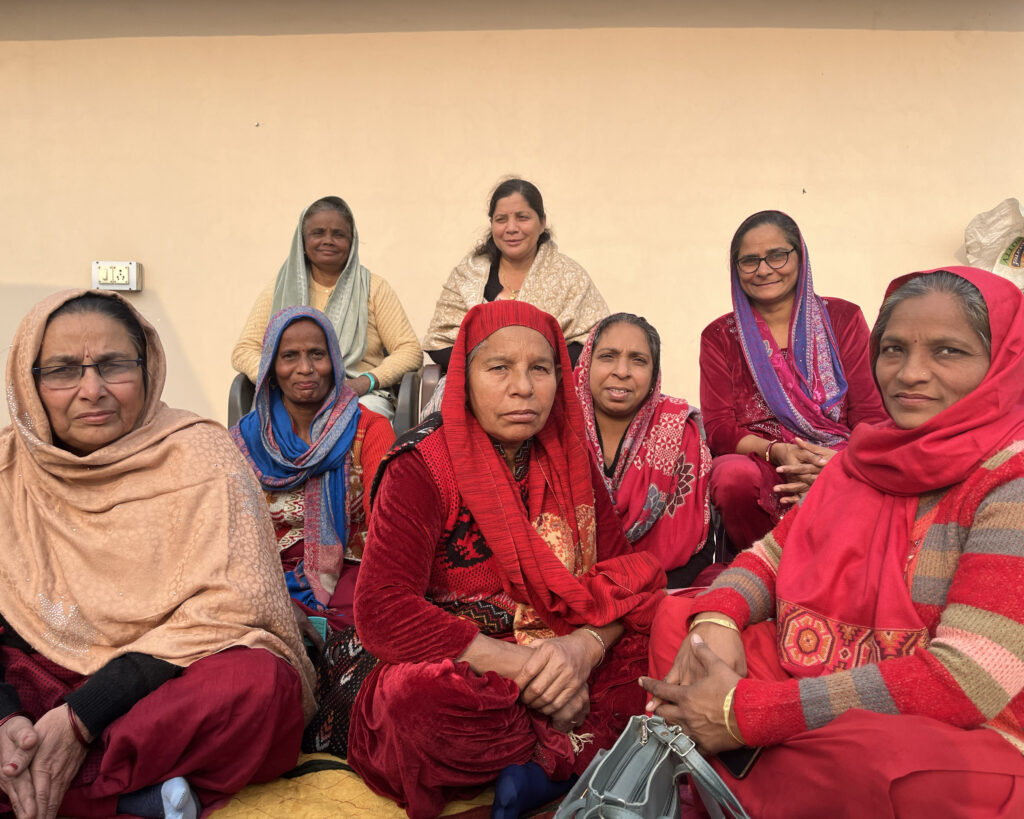
ASHA workers from Sonipat, Haryana. Photo by Priya Goswami.
Twenty years of care
Before ASHA workers became a household name, they had a singular mandate — instituted by the government of India in 2005 — to provide seva to pregnant women and children. Seva, a Hindi word with Sanskrit origins, means altruistic service and is often rendered selflessly in devotion to a cause. Devotion typically goes unpaid.
Seva remains the palpable north star for ASHAs nationwide. After all, “Who can a pregnant woman or a child turn to if not another woman?” This sentiment too often justifies extractive workloads, as ASHA workers from Haryana, a state in northern India, told me.
In 2022, following the COVID pandemic, the World Health Organization recognized ASHA workers nationwide with the Global Health Leaders Award for their role in quelling the spread of COVID in densely packed areas, risking their own lives. Today, as their role extends onto digital platforms, ASHAs are not only bringing care to the forefront but playing an important role in collecting health data. The data they collect includes family type (caste, class, religion), family size, history, current illnesses, assigned tracking numbers (such as in India’s Mother and Child Tracking System), and biomarkers, among other details.
In states like Haryana, one of India’s northern states, digitization is a priority, and ASHAs now have “as many apps as there are diseases,” as ASHA worker and Haryana ASHA union leader Sunita Rani explained. They are tasked with logging information via apps they are just beginning to understand how to use, as questions about digital literacy and a lack of official training on handling digital health records looms large. The data they collect is sent to the office of the Auxiliary Nurse Midwife (ANM), but what happens from there is not clear to the ASHAs. ANMs serve as a crucial link between ASHAs and higher officials; thus, what is mandated on the state or district level, such as the mandate to use a new app, or a new data point to be collected, ANMs present as an added to-do list item for the ASHA workers. The privacy of information accrued isn’t part of the equation; what’s important is what the ANMs ask of the ASHAs, many of whom are under severe pressure to deliver.
ASHAs range from 20 to 60 years of age, and while the senior ASHAs struggle to adapt to the phone-based work, some of the younger ASHAs face other cultural challenges. For example, Haryana is known for staunch patriarchal traditions and normative surveillance; under Khap panchayats, a young woman with a phone can be harassed for having “loose morals.” If there are issues with the network and poor connectivity, an ASHA may have to physically move herself within areas of better connectivity, which may make her susceptible to harassment or verbal attacks. Such instances are not rare. Rather it is one example of the many cultural challenges that come with having to keep digital records in a care setting, within a traditional framework.
But who signed up for digital labor?
Many ASHA workers have limited formal education and face traditional household constraints and limited earning options. Amid economic hardships and domestic pressures, the role often comes as a reprieve: allowing women to eke out a small income while earning respect within their communities.
Trust is the currency between people and ASHA workers, as they are often witness to personal stories and struggles, including domestic violence, harassment, sexual violence, or any kind of sensitive medical history. People, especially women, share freely with ASHAs what they cannot with doctors and other professionals, fostering a relationship grounded in trust.
Now add the dynamics of data collection. Prima facie, the information collected by ASHAs is harmless and can be an asset for policymakers to build actionable steps with data-driven insights. Yet health data, in the wrong hands, can be exploited by insurance companies and private hospitals. These data are also linked to the social identity numbers of Indian citizens, the AADHAAR IDs, which are in turn connected to bank accounts linked via mobile number.
As state and central initiatives of the digitization of records increase, along with the use of the internet and smartphones, so do One Time Password (OTP)-based scams. Scammers across India have found it easy to gain access to bank accounts and payments apps by tricking people into sharing their OTPs. Since ASHAs handle the phone numbers and records of thousands of people, many ASHAs have been accused of abetting scammers, leading to further harassment. Thus, many ASHAs, especially in Haryana, are demanding digital literacy training, in the hope of safeguarding themselves from such accusations, as well as building their own awareness.
ASHA workers from Mumbai, Maharashtra, also report being underpaid and blamed when “modern” health initiatives are slow to deliver: “If someone’s Ayushman Bharat Card [health cards for poor and middle-income families] has not arrived, they blame the ASHAs for not doing their job,” one told me. Across India, health data and governance remain a state matter, and the speed of uptake is directly related to an individual state’s preparedness and policies. States like Maharashtra haven’t caught up to the digital revolution of Haryana.
In a sharp contrast to Haryana and Maharashtra, in Kerala, India’s southernmost state, known for its highest literacy rate, ASHA workers are deeply trusted by the people they care for. People there understand how valuable their data is, especially when linked to their social security number, Aadhaar number, but “choose to trust their ASHAs,” as one ASHA from Kerala told me.
Regardless of recording methods or dominant culture, ASHAs’ work is bound to the implicit dynamics of trust and unwritten social codes across India. Traditionally, an ASHA would visit a home and spend time with the community based on their needs and at her discretion, without having to log data on apps. This has enabled ASHA workers to gain trust and help people in sensitive situations, sometimes outside of their official mandate — for example, navigating an incident of sexual assault when the survivor may not be prepared to report it.
Logging information on apps, digitizing records connected to social security numbers, and connecting phone numbers transforms this dynamic into one of record-keeping, chipping away at the original mandate of care-based service.
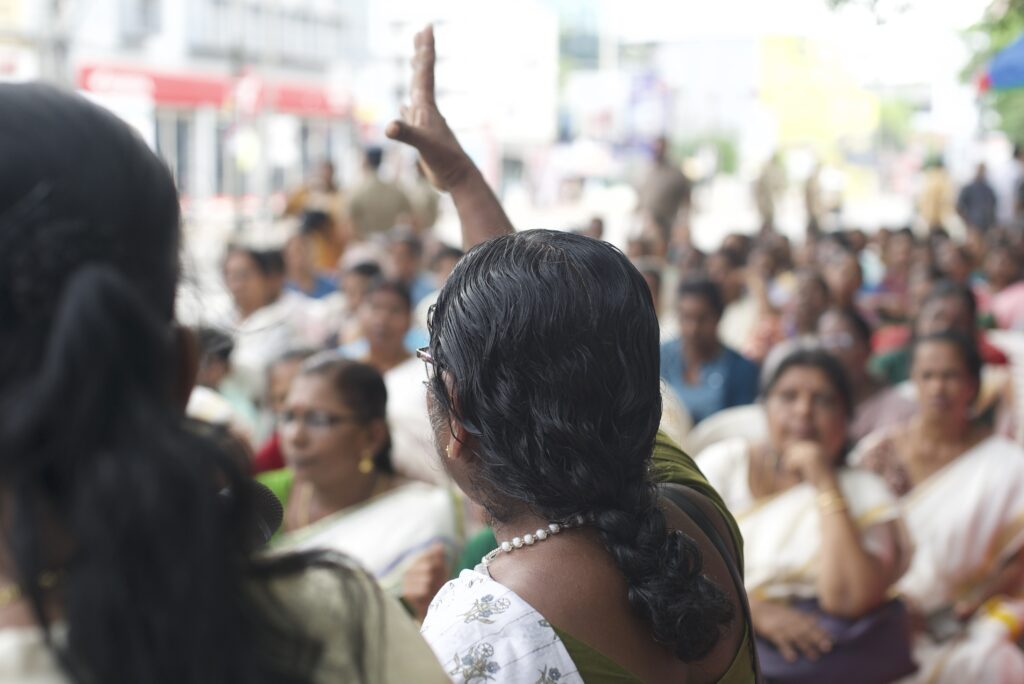
ASHA workers in Kerala protesting on May 1st, Labor Day, to demand better pay, dignity of work and recognition as government employees. Photo by Priya Goswami.
A delicate balance: people as infrastructure
Sociologist Abdou Malik Simone has written extensively about “people as infrastructures,” describing the extraction of “maximal outcomes from a minimal set of elements.” Employing ASHA workers as data laborers of digital India is a case of people being deployed as infrastructure of the state. Yet ASHAs are not recognized as formal government employees anywhere in India.
In expecting data labor from caregivers, we alter the nature of care, human-to-human connection, sisterhood, and how knowledge is stored and shared with communities. While it may seem efficient on the surface, data labor raises the question of whether bodies can be experienced or explained by data, especially in complex, socioculturally diverse places.
To understand the complex landscape of care labor demands on ASHA workers, I traveled from Haryana to Maharashtra to Kerala, meeting ASHA workers and the women and children they support. I saw firsthand how their unions and sisterhood keep them going, even amid rampant harassment and the escalating demands of work.
On May 1, ASHA workers protested outside the Secretariat in Thiruvananthapuram, Kerala, demanding better pay and recognition as government employees. Many went on a hunger strike for several days. In solidarity, LGBTQ activists joined the protest, enabling trans and queer individuals to speak in support of ASHAs. When I asked why they joined, they responded, “ASHA workers are frontline workers. They know what no one else does. They shield us.”
So what does it mean to do data and care work together? In a system designed to extract a maximal set of outputs with minimal incentives, with the omnipresent burden of selfless devotion expected from women, noting data on apps is yet another task in the ASHA checklist. It is one more thing she must do to get through the day, with implications she has little time to process.
Priya Goswami is a national award-winning Indian filmmaker and technologist who built a bot for survivors of gender-based violence called Mumkin. She is currently a Mozilla fellow, researching the impact of digital public infrastructures (DPIs), especially from the perspective of semi-urban and rural Indian women, and the ethical implications of AI ‘”companions” and anthropomorphized tech.