

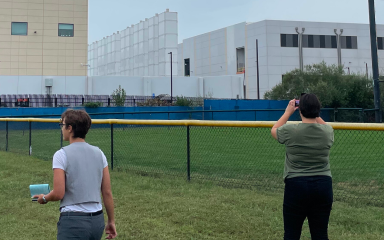
Recent coverage of data center propagation often seeks to communicate the scale of these developments by way of how they’re playing out in Virginia, illustrated by a visual glimpse into Data Center Alley. Photography and drone footage offer one way in. But there is something irreplaceable about firsthand experience. On a recent tour through Loudoun and Prince William Counties, organized by Nature Forward (a longstanding environmentally-focused nonprofit organization dedicated to conservation), Hannah was astounded by the totality of this development, despite what might have seemed like ample preparation through her work as a critical researcher on this issue. Driving for hours, the group passed scarcely more than data centers.
Northern Virginia’s robust fiber optic infrastructure (which itself is a result of the internet’s military origins), proximity to Washington, DC, and energy and land availability have propelled the region to its status as the world’s largest data center market. In June, a reporter at The Atlanta Journal-Constitution proffered Virginia as a “glimpse of the changes that could be on the horizon” for Atlanta, as its metropolitan area has become a target for planned data center construction. Similarly, advocates and officials in Maryland, already experiencing secondary effects from its neighbors, warn of data center creep. A central Pennsylvanian outlet, opening an article on local data center proposals, inadvertently summarizes the formula of this emerging news genre: “[In Northern Virginia], residents snipe at the centers’ aesthetic and ubiquity, elected officials tout the cold cash they bring, and a landscape provides lessons learned for other communities.”
The scale of data center buildout promised — or threatened — by the biggest corporate AI players is indeed on track to bring data centers to new communities at a pace that few could have predicted until recently. “I do guess a lot of the world gets covered in data centers over time,” OpenAI CEO Sam Altman posited on one podcast. The Trump administration’s AI Action Plan set this vision in motion: one tenet focuses on American infrastructure, calling for expedited environmental permitting through gutting of the Clean Air and Clean Water Acts, among other regulations, and opening up federal lands for data center construction and related energy infrastructure.
Sites of war, past and present
While data centers have comparatively deep roots in Virginia, they sit in a landscape already dotted with places of historic and cultural significance. Prominently, these include the preserved battlefields where some of the Civil War’s most decisive battles played out. On Nature Forward’s data center tour, Hannah and her fellow wanderers stopped for lunch alongside the tall meadows of the Manassas Battlefield where, across the street, residential and agricultural land had been rezoned for the largest data center complex in the world: the Digital Gateway. Similarly, the “Wilderness Crossing” data center project evokes the pastoral but instead references its slice through the Wilderness Battlefields. These projects have proved to be points of significant activation for communities; both are tied up in years-long legal challenges.
The contemporary intrusion of data centers isn’t the only temporal link onsite. Inexorably linked to the modern warfare of today, the grassy topographies of the Civil War battlefields evoke a far different image of militarism than the datafied technologies currently under development in the Defense and Intelligence Industry Corridor that runs through and alongside the contours of Data Center Alley. In a prescient 2014 essay, writer and artist Ingrid Burrington registers this “uneasy resonance of the surveillance landscape” in Northern Virginia, “where large pieces of infrastructure in the new global battlefield are adjacent to battlefields from a very different conflict.”
Today, the artillery of war is not so much forged in factories as it is stored inside data centers — alongside information about our locations, browsing habits, facial features, immigration status. The federal government, especially under the current administration, is increasingly explicit in its desire to leverage this data for violence. One of the directives in the administration’s AI Action Plan is to “aggressively adopt AI within [the country’s] Armed Forces,” both when it comes to warfare and back-office bureaucracies. Among the recommended policy actions under this principle is for the government to “prioritize [Department of Defense]-led agreements with cloud service providers, operators of computing infrastructure, and other relevant private sector entities . . . so that DOD is prepared to fully leverage these technologies during a significant conflict.” Put simply: the government is unleashing a frenzy of contracts with private industry — the very companies descending upon communities with NDAs and construction cranes — while investing in data centers as part of a national military strategy so that AI technologies can automate the machinery of war.
Northern Virginia’s imbrication in this industry makes it another site for comparison, but not necessarily resonance, with other communities. The same factors that made the area a hub for data centers — proximity to DC, onsite military R&D, leading-edge communication infrastructure — also catalyzed its economic successes and built a prospering workforce. As a result, the broad coalition fighting the data center industry that coalesced here has not necessarily built a consensus about what these data centers are doing. One can see this in the careful contestation of what the “right” kinds of economic development are for the region. Residents in Albemarle County, for example, about 100 miles south of Loudoun County, bitterly contested a recent proposed ordinance that would have eased certain restrictions for approval of new large-scale data centers. Shortly after tabling that ordinance, the Board of Supervisors unanimously passed the county’s five-year Economic Development Plan, which opens the door for a concerted buildout of its military industry: the plan’s first goal (of five) is to “lead in intelligence and national security.”
In fact, the military sector is the second-largest industry in Albemarle County. In 2023, the county spent $58 million to purchase 462 acres of land adjacent to the existing Rivanna Station, a military campus outside of Charlottesville that is home to the National Ground Intelligence Center. The expanded site, known as Rivanna Futures, is being marketed as a way to attract high-wage employees and jobs while allowing Albemarle to become a “hub for intelligence and national security innovation and economic growth.” The land will become part of Virginia’s developing Defense and Intelligence Industry Corridor, which will run the 60 miles from Fauquier County in Northern Virginia to Charlottesville in central Virginia. This statewide economic project includes a defense production zoning overlay district in Greene County, where incentives seek to lure defense contractors, and campuses for Northrop Grumman and General Dynamics.
Local opposition to these developments was muted, Charlottesville-based peace activist David Swanson recounted to us. As Rivanna Futures moved forward, Swanson told the C-VILLE Weekly, “‘If anybody else wanted to buy land, for a hospital or affordable housing or a park or a nature preserve or a gas station, they’d have to pay for it themselves….Why should the county pay for the wealthiest institution there is?’’
Elsewhere, similar questions animate contestations of data centers, particularly in communities highly attuned to the immediate impacts of the surveillance state. Organizers in the No Desert Data Center campaign discussed how networks already organized around immigration justice activated when Amazon Web Services sought to build a data center in Tucson. “When we found out it was Amazon, there were a couple of other angles to take too, including that Amazon works with Palantir on surveillance. It has been surveilling immigrants for years . . . But now, they’re going to be surveilling US citizens as well,” Vivek Bharathan of MediaJustice explained on the Tech Policy Press podcast. Bharathan’s colleague, MediaJustice Executive Director Steven Renderos, added that these are “the surveillance technologies that are being used by federal and local law enforcement agencies to target and criminalize protests.” Communities, he noted, know that this data “all lives somewhere.”
These concerns go beyond the first-order impacts on next-door communities. To what extent are fights against data centers linked to broader struggles for rights, justice, and privacy unfolding in an increasingly algorithmically-governed, environmentally-volatile world? The very technologies currently being innovated in the Pentagon’s backyard are the same ones used to surveil activists and drop bombs overseas. As the planet warms and borders close, AI expansionism concentrates power among the already-powerful, and people’s rights become even more precarious.
Many data center alleys
Even within Virginia, data center fights and impacts are not uniform. On one hand, a significant amount of data center governance happens at the county level. County planning commissions are often given authority to approve individual projects, though localities are starting to adopt processes that require a board of supervisors vote and public hearings. However, a board of supervisors elected by residents in one county increasingly affects communities outside their jurisdiction. A project in Loudoun County, for example, may require new transmission lines that slice through Maryland and West Virginia. Meanwhile, coal plants in West Virginia pollute the air of local residents, only to send the resulting energy to Data Center Alley. As lawyer and journalist Jenna Ruddock, who has been actively involved in Virginia site fights as well as national campaigns, told us, these geographic crosscuts can be particularly fruitful sites for coalition building; electrical infrastructure that cuts through both public and private conserved lands, including parks and farmland, bring together dispersed and diverse stakeholders.
Data centers also highlight the dense cluster of public and private entities involved in development decisions, any one of which could determine the course of a local fight. Based on her long-term ethnographic fieldwork, the media studies scholar Lauren Bridges notes the outsized role played by Dominion, Virginia’s primary utility company, as it profits from data center expansion alongside data center operators. In 2023, in response to concern from Dominion and the regional grid operator that they would be unable to meet the energy demand of existing facilities, the state’s Department of Environmental Quality offered to ease pollutant limits for data centers, allowing them to run heavily-polluting diesel backup generators to offset the strain on the electric grid. The DEQ withdrew this proposal after community protests, as residents raised concerns about air pollution and subsequent health impacts. In exploring these competing “digital capacities,” Bridges exposes the many frictions between private corporations, elected officials, public regulators, and frontline communities. In any given locale, power may be aligned in vastly different arrangements between any number of these stakeholders.
As effects ripple out, the areas surrounding northern Virginia are increasingly attuned to and activated about data center effects. Well-established networks closely track regional development and can turn people out in the near-thousands to attend local meetings. Yet this is not necessarily a given for communities that are new to the fight. Data center negotiations are notoriously shrouded in secrecy — huge tech companies often operate as shell companies that require planning officials to sign non-disclosure agreements. Residents may not even find out that a project is coming to town until after it has been approved. With this significant asymmetry of knowledge and power, it is difficult for local residents, let alone neighboring or downstream localities, to organize effectively. As data center companies increasingly target less-prepared neighborhoods, other communities may need thoughtful engagement and power mapping with existing organizing networks to understand how they are best positioned to respond. Virginia offers critical models for response, but should not be understood as the one-size-fits-all approach. Other strategies — including those long-employed by communities at the frontlines of extraction and environmental sacrifice — may provide novel roadmaps.
Still, as this unfolds, there is a significant strategic need for groups to educate and collaborate across fields. A number of Virginia-based activists have been working diligently, for years now, to collect data, develop resources, and build relationships both on the ground and above it. The Piedmont Environmental Council has been active since well before the AI-stimulated frenzy, producing introductory material and comprehensive maps. Clean Virginia has organized to counter the utility company’s influence in deepening the energy crisis brought on by data centers. Both groups helped form the Virginia Data Center Reform Coalition — now host to over 50 member organizations — to develop pillars for responsible data center growth, focused on fair distribution, increased transparency, statewide oversight, and efficiency requirements. Journalists have linked knowledgeable sources, striking a balance between investigative journalism, op-eds, and amplification of local voices. Scholars have linked academic sources on data infrastructures to on-the-ground local fights. There is no need to reinvent the wheel — particularly when data center companies and the tech industry are counting on us to get stuck spinning as they foist their infrastructure on us.
The data center fight is just one piece in the matrix of how the tech industry is seizing control over entire swaths of society: infrastructure, energy systems, commerce, military, government. Treating data centers as an isolated issue can only take us so far. More fundamentally, assuming that the best policy will only emerge from those already in seats of power risks replicating the same tired patterns. Instead, organizations must engage proactively and earnestly with the communities most affected by tech infrastructure and the industry’s immense power.
The danger latent in the data center fight is that we reduce our efforts to battles over individual sites, seeing each data center as a discrete point in space and time. Instead, we must understand data centers and their attendant infrastructures as just one element in the digital lattice of authoritarian technocracy. The same forces that converged in Virginia to form the heart of the data center industry concomitantly converged there to form the heart of the military industrial complex: a geographical nexus for the developers, customers, and policymakers that comprise this very lattice. These established forces have required local advocates to be creative and strategic in their efforts, where organizers elsewhere may feel more latitude.
As researchers, in addition to tracking individual site fights around data centers, we’re looking at how the politics, economics, and cultural factors of a place inform what strategies are possible and effective. Our intention is to connect situated data center politics to the larger systemic harms afforded by data center expansion and data centers’ relation to the fossil fuel industry and surveillance state. Through targeted, place-based data center research, we can see how pervasive, existential climate and societal issues show up at the local level and develop a political strategy beyond blocking individual data centers. This means proactively building wide coalitions with those resisting the malignant forces of surveillance, militarism, resource extraction, and inequitable automation — workers, immigrant rights defenders, climate and privacy rights activists — within regions like Northern Virginia, and beyond and across them.