

“[There] is a strategy that puts the onus on the workers to adapt, instead of making sure that industry and government [are] held responsible and accountable for the decisions they make that impact our lives.”
– Anuli Akanegbu
Description
In her new report (404) Job Not Found: What Workforce Training Can’t Fix for Black Atlantans in the Age of AI, Data & Society researcher Anuli Akanegbu provides the first ethnographic examination of how AI-related skills are defined, taught, and valued across Atlanta’s growing tech economy. Drawing on interviews, field observations, and historical analysis, she traces how AI literacy is promoted by industry, implemented by government, and interpreted by workers and community leaders navigating an increasingly AI-driven workforce infrastructure.
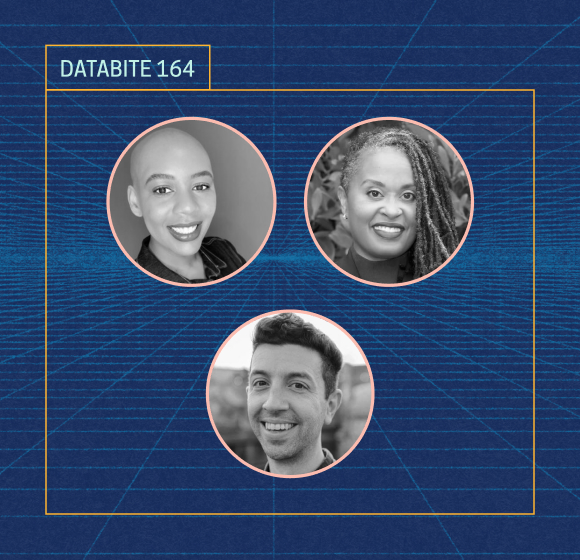
On February 17, Akanegbu, TechEquity Senior Vice President of Labor Programs Tim Newman, and Bard Computer Science Professor Annabel Rothschild held a critical conversation on the policy stakes of AI-focused workforce development at the state and national level. Informed by Akanegbu’s report and an accompanying policy brief co-authored by D&S Policy Manager Serena Oduro, who moderated this conversation, panelists discussed how government and industry priorities shape workers’ access to opportunity and how policy can address the real-world impacts of automation and AI on workers.
Unfortunately, Senator Nikki Merritt was unable to join the panel as scheduled, as it unexpectedly coincided with a long Georgia state legislative session.
Author

Anuli Akanegbu, PhD, is the author of the report (404) Job Not Found and a researcher with Data & Society’s Labor Futures program, where she leads projects that explore the intersections of labor, race, and technology. Guided by Octavia Butler’s directive to “tell stories filled with facts,” her work traces how Black workers navigate structural inequality, technological change, and economic instability, drawing on ethnographic fieldwork and archival research to show how labor, policy, technology, and the virtual and physical spaces of cities shape how people live and work. Learn more about Anuli at her website.
Speakers

Tim Newman is the senior vice president of labor programs at TechEquity, where he leads the organization’s research and advocacy focused on the tech industry’s impact on work and labor. Previously, he worked for Coworker.org, Change.org and the International Labor Rights Forum. He is an affiliate of the DISCO (Digital Inquiry, Speculation, Collaboration, and Optimism) Network.
Annabel Rothschild is an assistant professor of computer science at Bard College. Her research centers the “who, when, where, how, and why” of dataset creation, focusing on how the datasets used to train and refine AI systems come into being and the values and attitudes they represent. She holds a PhD in human-centered computing from Georgia Tech, where she was a member of the DataWorks project for five years.
Moderator

Serena Oduro is policy manager at Data & Society, where she leads the organization’s state-level policy engagement. She is co-author of the brief (404) Job Not Found: How Government Can Help AI Education Deliver Real Benefits for Workers. Serena is a Ragdale HUMAN Residency Fellow and 2025 DISCO Research Network Affiliate. Previously, she was a technology equity fellow at The Greenlining Institute, where she provided key support for Greenlining’s sponsorship of California’s Automated Decision Systems Accountability Act of 2021.
References
Readings
- Anuli Akanegbu, “Georgia Must Regulate AI in the Public Interest to Thrive in This Age,” The Atlanta Journal-Constitution (2026)
- Data & Society, “Building Civic Strength for an AI Era,” Points (2026)
- Lawrence Ukenye, “DOL Rolls Out AI Literacy Framework for Workforce Programs,” Politico (2026)
- Pallardy et. al, “AI & Workplace Development: Building a Secure, Equitable Future for Tech Workers,” TechEquity (2025)
References
- DataWorks | Workplace training program and data services provider of which Annabel Rothschild was a co-founder
- Jim Burress, “Atlanta Study Questions What ‘AI-Literate’ Means for the Job Market,” WABE (2026)
Credits
Production: Iretiolu Akinrinade & Tunika Onnekikami
Editorial: Eryn Loeb
Design: Surbhi Chawla
Additional support provided by Data & Society’s engagement and accounting teams.