

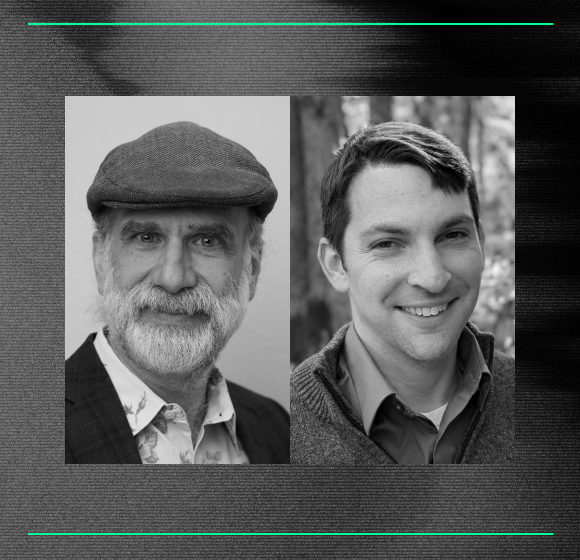
“[T]o reform the ecosystem of AI, we as a society need to actively be shaping how AI is developed and used, and how that will be done in the future. And part of that involves working through the government.”
— Nathan E. Sanders
“If we only see AI as [providing] misinformation, as propaganda, as extractive, or as biased, we’re not going to be open to the promise of the good things it can do. And we’re also not going to [be able to] steer it.”
— Bruce Schneier
Event ⋅ October 23 2025
A Roadmap for Rewiring Democracy in the Age of AI
Nathan E. Sanders
Bruce Schneier
Alice Marwick
Description
Democracy faces challenges worldwide, and artificial intelligence has become an increasing part of that. In their book Rewiring Democracy: How AI Will Transform Our Politics, Government, and Citizenship, cybersecurity technologist Bruce Schneier and data scientist Nathan E. Sanders methodically unpack the ways AI is changing every aspect of democracy, while making the case that we can harness the technology to support and strengthen these systems. Neither fear-mongering nor utopian, Rewiring Democracy aims to present a clear-eyed and optimistic path for putting democratic principles at the heart of AI development — highlighting how citizens, public servants, and elected officials can use AI to expand access to justice and inform, empower, and engage the public.
On October 23, the authors discussed their book with Data & Society’s Director of Research Alice Marwick, walking us through their roadmap for understanding how AI is changing power and participation and what we can do to shape that change for the better.
Speakers

Bruce Schneier | X: @schneierblog
Bruce Schneier is an internationally renowned security technologist and the New York Times bestselling author of fourteen books, including Data and Goliath and A Hacker’s Mind. He is a lecturer at the Harvard Kennedy School, a board member of the Electronic Frontier Foundation (EFF), and chief of security architecture at Inrupt, Inc.

Nathan E. Sanders is a data scientist focused on making policymaking more participatory. His research spans machine learning, astrophysics, public health, and environmental justice. As a Berkman Klein Center Fellow, he co-founded MAPLE, the Massachusetts Platform for Legislative Engagement, which makes it easy for Massachusetts residents to testify to the state legislature. His writing on AI and democracy has appeared in The New York Times, The Atlantic, Wired, and Foreign Policy, among other publications.
Host
Resources
References
Readings
- Nathan E. Sanders and Bruce Schneier, “Let’s not make the same mistakes with AI that we made with social media,” MIT Technology Review (2024)
- Bruce Schneier, Nathan E. Sanders, and Josh Kramer, “Will AI break democracy or fix it? Yes.,” New_Public (2025)
- Bruce Schneier and Nathan E. Sanders, “AI Will Be Your Personal Political Proxy,” AI Frontiers (2025)
- Maya Y. Fu, Helia M. Hung, and Adelaide L.D. Roger, “Tech Experts See Artificial Intelligence as a Key Resource Ahead of Local Elections,” The Harvard Crimson (2025)
Credits
Curation: Iretiolu Akinrinade
Production: Tunika Onnekikami
Web Support: Alessa Erawan
Design: Surbhi Chawla
Editorial: Eryn Loeb
Additional support provided by Data & Society’s engagement and accounting teams.