

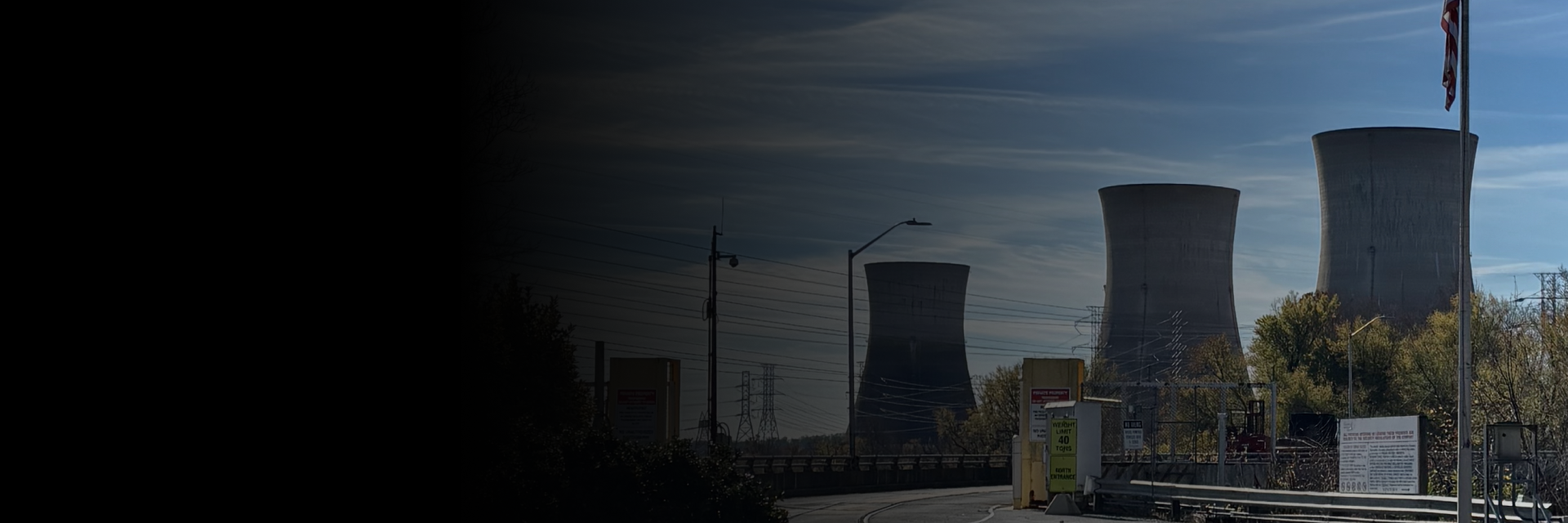
Three Mile Island, site of the worst nuclear disaster in US history, is coming back online to power the AI boom. Livia Garofalo, Joan Mukogosi, and Maia Woluchem explore what this means for the surrounding community.
Three Mile Island, site of the worst nuclear disaster in US history, is coming back online to power the AI boom. Livia Garofalo, Joan Mukogosi, and Maia Woluchem explore what this means for the surrounding community.
August 20, 2025
As you approach the Three Mile Island Nuclear Generating Station near Middletown, Pennsylvania, southeast of Harrisburg, the stacks stand out in stark contrast against the Susquehanna River and the surrounding hills. Across the railroad tracks from the facility’s entrance, homes and lawns dot the road. Local golfers swing their clubs and count their strokes at a public course that overlooks the nuclear plant.
Opened in 1977, Three Mile Island (often abbreviated to TMI) rose to public consciousness in 1979, when it became the site of the worst nuclear disaster in US history. Now, TMI has returned to national attention. Under a deal between one of the site’s owners, Constellation Energy, and Microsoft, by 2028 the new Crane Clean Energy Center will provide nuclear-powered energy exclusively to Microsoft and its data centers, and do so for the next two decades. As The Washington Post reports, this would be the first time a US nuclear plant was brought back into service after being decommissioned, and the first time a single commercial nuclear power plant’s output was allocated to a single customer. Though once lost to time, the next chapter of Three Mile Island’s story is about powering the AI boom.
How do residents of Middletown and the surrounding Londonderry Township make sense of the plant’s reactivation, and the fears, hopes, expectations, and skepticism that accompany it? How is AI transforming energy infrastructures and the communities that construct them? Moreover, what do these sites of transformation tell us about where the AI race is leading us?
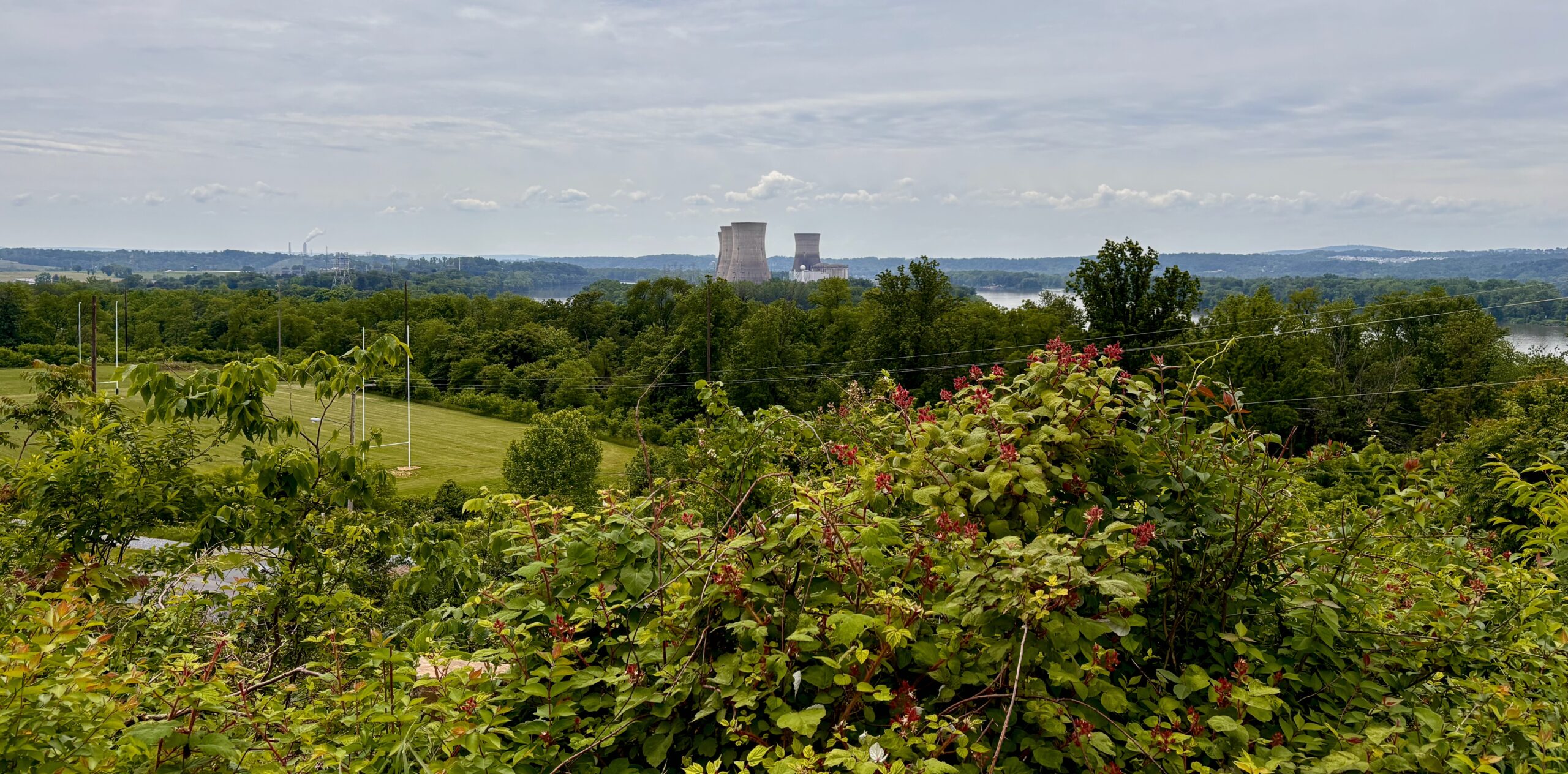
A view from the Sunset Golf Course, Londonderry Township, PA
On our second trip through Pennsylvania as part of our research following the state’s industrial histories and futures and nascent data center industry, we returned to TMI, itself a vestige of confrontations between industrial aims and community. In the 1970s, the arguments for building the facility were similar to those repeated today: TMI would be a job creator, reinvigorate local pride by participating in an energy renaissance and invite the promise of a prosperous, innovative future.
On March 28, 1979, Unit 2 of the nuclear generator experienced a mechanical failure, resulting in the reactor’s partial meltdown and a release of radioactive waste into the surrounding air and water. Communication from the TMI’s representatives and federal authorities was inadequate, contradictory, and poorly coordinated. The day after the failure, schools were closed, and residents of Middletown were asked to stay indoors to protect themselves from potential radioactive fallout. In the following days, families as far as New York City, Philadelphia, and Washington, DC were put on alert and the population of Londonderry Township was encouraged to evacuate. Within a month, most evacuees had returned home, though the lasting impacts of the accident remain disputed.
After the accident and the subsequent plant closure, Unit 2’s clean-up operations took twenty years and $1 billion. TMI-1, which had not experienced issues, was restarted in 1985 and was in active operation until 2019, when it was shut down due to operation costs. Decades later, evidence of the accident’s impact is hard to parse, oscillating between local stories of prevalent cancers and psychological distress, federal reports of minimal residual nuclear waste, environmental concerns, and those who lament the sputtering restart of the plant, which was responsible for hundreds of jobs. Though spared the impact and fallout of Chernobyl, the incident at Three Mile Island had a lingering legacy that affected US nuclear policy for decades after, halting the construction of new reactors for many years.
The surprising news of Unit 1’s 2028 reactivation, in agreement with Microsoft, has elicited mixed reactions. For some proponents, the cooling stacks still towering over Middletown offer new promises of renewal, employment, and the American energy independence deemed necessary in the era of AI. For others, the plant’s reopening brings up traumatic memories and environmental fears, along with well-founded worries that large corporations, rather than the local community, will benefit the most.
Eric Epstein, the chairman of Three Mile Island Alert, a non-profit organization and nuclear watchdog founded two years before the 1979 accident, has seen many debates about TMI’s restart over the last several decades. We meet Eric in a mall outside Harrisburg, where the awning of a defunct Bon Ton department store betrays the passing of time. He jokes that the mall is half empty, almost a “tomb.” A bowling alley once sat across the way, he remembers, a place where people would get rowdy on Saturday nights in the ’70s. We sit in a mostly vacant food court and talk about TMI’s reopening, energy costs, environmental impacts, data centers, and Pennsylvania’s economic development. Behind us sits an empty “Fresh Italian” restaurant, while across the way, a tailor and dry cleaner’s storefront shares space with a lone Amazon locker, the indirect culprit of the mall’s demise. “This is what I anticipate data centers are going to look like in twenty years!” Eric says.
“TMI is proximate to a coal plant, a hydro plant, there’s a lot of fishing and a lot of summer homes,” he explains. As for TMI coming back online, he’s concerned about the high energy demands and its effect on the grid, the misleading promises of high employment, the intense environmental impact and pressure on the Susquehanna River: “What people aren’t getting [is that] the data centers are actually taking energy off the grid, and exacerbating a problem. Now you have a situation that we’ve never confronted.” Data centers, he emphasized, run 24/7.
Middletown is like many Pennsylvania communities facing the brunt of downfalls in the state budget alongside dwindling federal funding, as well as a difficult recovery from decades of declining manufacturing investments across the state. Combined with the closure of public universities and the shutdown of a local steel mill that once employed thousands, Eric believes Middletown is now in pursuit of what he calls “the pirate false gold of data,” much like other towns that invest in AI infrastructures in the hope of a more economically robust future. State lawmakers and the local Building Trades Union talk about the rebooted TMI and incoming data centers as job creators capable of reinvigorating an innovation economy. Eric doesn’t buy it. “People don’t get that Three Mile Island is an industrial complex,” he says. “I feel most people have been persuaded into viewing TMI, nuclear, and data centers in a positive way.”
Yet the political and economic intentions of these transitions aren’t lost on Pennsylvanians. As Eric says, “we’re fighting an AI war against China and it’s being fought in Pennsylvania.” War-time advertising was reflected at July’s AI and Energy Summit, which gathered state lawmakers, major tech investors, and President Trump himself to celebrate nearly $100 billion in investments to build data centers and energy infrastructures across the state. One after another, speakers at the Summit championed Pennsylvania as the center of the American AI revolution, framing the influx of state-wide investments as an offensive maneuver in the AI race against China. This AI-centered future requires energy sites like TMI; from fracking, coal, and oil; as well as significant amounts of water that often strip localities of their own natural resources. As Eric notes, “It’s amazing how many major environmental landmarks happen here, and then how many major catastrophes occur.”

The following morning, we stop at Kuppy’s, a small diner in the center of town that has remained under family ownership and operation for three generations. At the time of TMI’s Unit 2 failure, federal regulators held press conferences here, downplaying the risk of widespread nuclear waste in the ground, air, and water. Mayor Robert Reid spoke in front of journalists, giving evacuation orders to Middletown’s residents. When we visit the diner four-and-a-half decades after that announcement, the former mayor himself sits at the bar eating breakfast, still a regular. One of the diner’s owners tells us she hopes the plant will bring back some business and jobs that are now hard to find.
The endurance of Kuppy’s and the eerie emptiness of the local mall stand in stark contrast to the shine of TMI’s restart and the proposed technology of the future. In need of jobs and revitalization, residents of Londonderry Township and Middletown are faced with difficult choices about whether and how to welcome AI-driven industrial change to their communities. Having lived through the cycle of optimism and failure that surrounded TMI’s initial launch, residents are the recipients of a new wave of pledges offering them a key role in a global race to build infrastructure for AI, and a supposed place in history. As Eric acknowledges, “You bring a data center to a community, it’s hard to say no.”
All photos by Livia Garofalo.
Interested in how data centers are reshaping our world? Read this policy brief breaking down four key myths about data centers by program directors Tamara Kneese and Maia Woluchem, check out our previous dispatch from Pennsylvania, and stay tuned for our next piece on data center futures in Pittsburgh.